
Vivien Bard (1895-1985): THSO’s First Resident Composer
David Chapman | May 29, 2026 | history@thso.org
Daniel Powers has been the official Composer-in-Residence of the Terre Haute Symphony Orchestra for more than thirty years. During that time, the THSO has premiered his overtures, concertos, arrangements, re-orchestrations, and more. We have been very lucky to have him on the team for so long and have benefited greatly from his talent and generosity over the years.
Dan is not the THSO’s first resident composer, however. Vivien Bard was as close to a composer-in-residence as could have existed in the early decades of the THSO. Today we look at Professor Bard’s extraordinary thirty-year service to our orchestra as performer, composer, board member, Vice President, and more.
Bard as Pianist
Vivien Nemo Bard was born in Terre Haute on April 24, 1895, an alumna of Wiley High School, and a lifelong member of Centenary Methodist Church. Except for undergraduate music studies at DePauw, master’s degree work in Chicago, and a few years teaching in Nebraska, she lived nearly all of her ninety years on Center Street in Farrington’s Grove.
Bard’s talent as a pianist manifested early. During her teen years she studied piano with local virtuoso Anna Hulman. Hulman had an extraordinarily prestigious musical pedigree, having studied with legendary Polish pianist Theodor Leschetizky, whose teacher had been Carl Czerny, one of Ludwig van Beethoven’s most famous students. By studying with Hulman, Bard herself became a part of that distinguished musical lineage.
Bard may well have attended Carl Eppert’s THSO concerts in 1904 to 1907. Not only would those events have been the musical talk of the town and of interest to a young performer like Vivien, but the Bards and the Epperts were fellow members of the same church, and the orchestra rehearsed and performed several times at her high school.
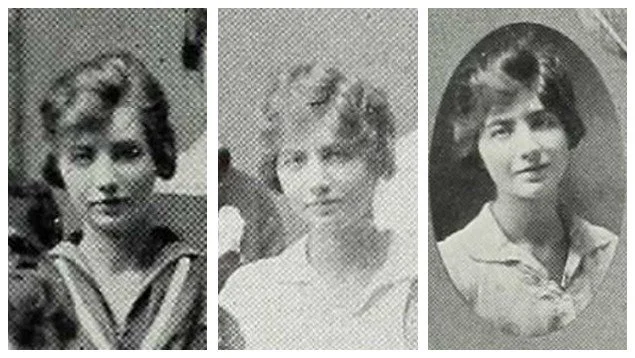
Photos of Vivien Bard, approximately 20 years old, from DePauw University’s The 1916 Mirage yearbook.
Bard studied piano with Rosa Blackmore at DePauw University from 1915 to 1917, with Polish pianist Heniot Levy at the American Conservatory in Chicago from 1917 to 1919, and later with famed Russian pianist Josef Lhévinne during his summer masterclasses in 1921 and 1923. By studying with Levy, Bard became an heir to a musical inheritance that traced back to Franz Liszt. Even without such pedigrees, each of her teachers adopted her into prestigious piano traditions, introducing her to the instrument’s broad repertoires and diverse teaching techniques. These would form the basis for her main professional career for the next sixty years.
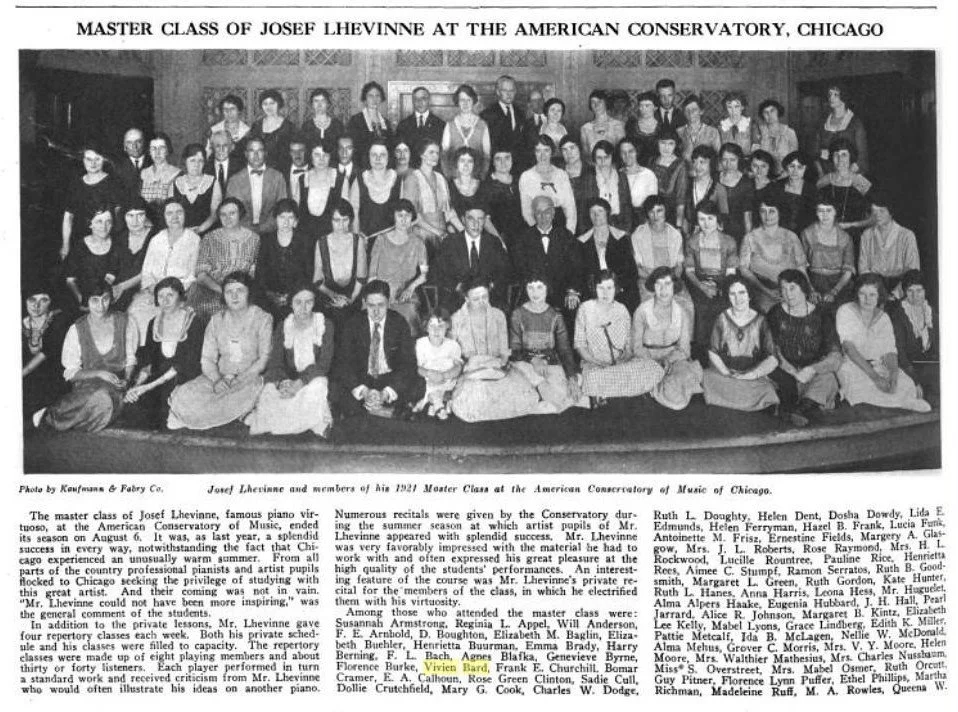
From the Musical Courier, August 25, 1921, page 12.
In 1919, with a new master’s degree in hand, Bard became a piano instructor at the Normal School in Chadron, Nebraska. She performed regularly as a soloist in recitals and with orchestra, and often appeared in a chamber trio with two of her string colleagues. She taught piano in group classes and in private lessons, developing a teaching studio from talented local students. One of her star pupils from that era, Leroy North, won the gold medal in Nebraska state competitions in 1922.
Bard returned to Terre Haute in 1922, set up a new private piano studio in her parents’ home on Center Street, and resumed her studies with Anna Hulman. Over the next few years, she took on local piano students, taught class piano, and played recitals throughout the near midwestern region.
“[Bard] Gives Chopin Recital in Home City: Former Instructor Here Gives Finished Program”
Just a few weeks after the THSO’s first concert in December 1926, hosted by the Woman’s Department Club, the Club also sponsored an all-Chopin solo piano recital performed by Bard at the First Congregational Church. The Terre Haute Star reported afterward that Bard “has the happy faculty of interpreting Chopin which requires fine technical dexterity, an understanding of poetry, imagination, grace and charm, all of which Miss Bard’s playing expresses.” She repeated the program at St.-Mary-of-the-Woods several weeks later.
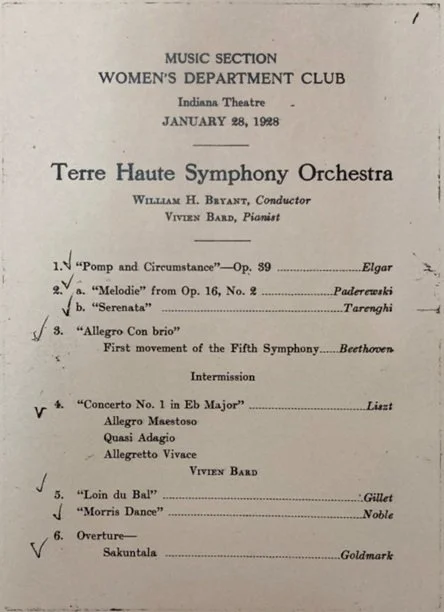
When the Department Club hosted the THSO’s first anniversary concert the next year, Bard was the featured soloist. She performed three out of four movements from Franz Liszt’s Concerto in E-flat Major. Reviews later described her performance as the highlight of the concert.
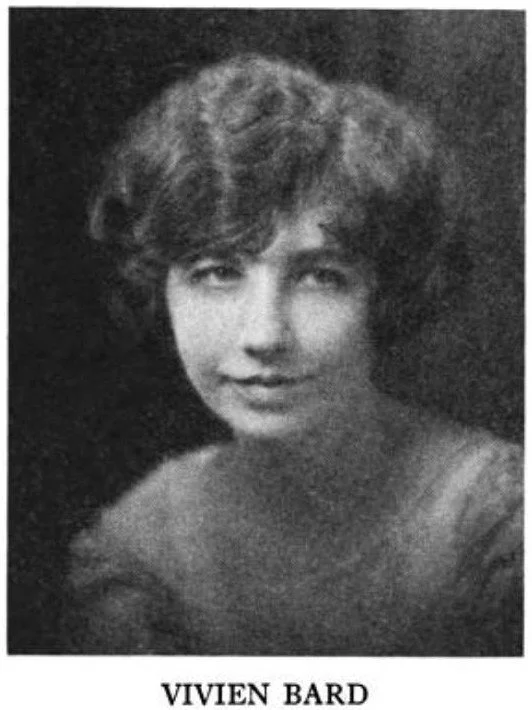
Portrait published in The Lyre of Alpha Chi Omega, October 1929, page 71.
Bard as Composer
To discuss Bard’s career as a composer, we must go back in time to her studies at DePauw in the mid-1910s. The first public notice of these talents came from a composition competition during her freshman year. Lyrics for a new “football song” written by DePauw student Carl Helm were published in the DePauw Daily student newspaper, with an invitation for musical settings. Professor Van Thompson encouraged students in his composition class, including Bard, to submit composed settings of the lyrics. Ten days later the newspaper announced that Bard’s setting of “Yea DePauw” had been chosen and announced at a recent convocation. “At the conclusion of each chorus Dean McCutchan was compelled to wait for some time until the cheering had subsided.” For her success she was presented with a $10 gold piece.
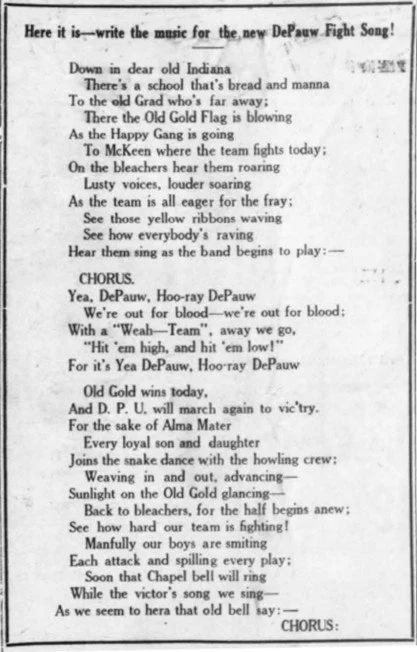
Lyrics to “Yea DePauw,” written by student Carl Helm, published in the DePauw Daily student newspaper on October 1, 1915.
“Vivian [sic] Bard Writes Music for DePauw’s New Football Song”
Author’s note: I would be very eager to see a notated score of “Yea DePauw,” but I know of no existing score. If any reader has a copy or knows where this or any of Bard’s works may be found, please let us know! Until then, we have only Helm’s lyrics for the song and, sadly, not Bard’s prize-winning tune. Unfortunately, this is an all-too-common state for Bard’s compositions, as we will see.
An even greater triumph took place just as she was finishing her Bachelor of Music degree in 1917. Bard wrote a toast song for her Alpha Chi Omega sorority that proved so popular that she was asked to rewrite the lyrics to apply to the entire school. Toasts were uneasy things during the Prohibition Era, and very early on it became the practice to raise an empty hand rather than a proper drink during Bard’s “Toast” song. You can see the gesture near the end of this video:
In 1920, DePauw published a collection of its school songs, and Bard’s “A Toast to Old DePauw” appears first in the book. The revised song soon became the school’s official Alma Mater and remains so today. It may well be her best-known work as a composer.
Vivien finished her degree at DePauw in 1917 and moved to Chicago to continue her studies. During her master’s degree work at American Conservatory, she studied not only piano with Professor Levy but also composition with songwriter Arthur Olaf Anderson. That work resulted in a three-movement Sonata romantique in G major for piano and a single-movement Romance in E-flat major for piano, violin, and cello. A song, “Slumber Time,” also came from this fruitful period, and appeared with some frequency on vocal recitals for the next two decades. Throughout her years as an instructor in Nebraska, and after her return to Terre Haute in the early 1920s, Bard produced a steady stream of new songs and short piano pieces for young students, many of which were published and sold commercially.
After performing with the THSO as featured soloist in 1928, Bard joined the orchestra again for the Depression-era Percy Grainger concerts at Indiana State. During these same years, she was hard at work on the largest composition of her career to date: a three-movement Concerto in G minor for piano and orchestra. She debuted the work with the THSO on March 16, 1934. In promoting the concert in the weeks before, the Terre Haute Saturday Spectator urged Hauteans to attend, arguing that “Vivien is an artist in every sense of the word and a chance to hear her play her own composition should not be missed.”
The performance was apparently successful enough to merit a repeat performance only a few months later. When the Woman’s Department Club invited the THSO to perform at First Baptist Church the following September, the program included Bard’s Piano Concert in G minor once again.
No recording or score of Bard’s first Piano Concerto is known to exist.
Bard as THSOA Board Member
During the THSO’s 8th season (1933-1934), Bard expanded her service to the organization from performing and composing to becoming a member of its newly reconstituted Board of Directors. She remained on the board for the next twenty years, even serving as Vice President from 1939 to 1941. (Later claims that she served as President appear not to be correct.)
Despite her busy schedule, she continued to write new music. In the late 1930s, she composed an even more ambitious work: a three-movement Triple Concerto for piano, violin, cello, and orchestra. It was premiered on an “Indiana Composers Concert” by the THSO on March 21, 1939, alongside works by THSO conductor Will Bryant, William Pelz (director of Indiana’s Federal Music Project), and Malcolm C. Scott (Gerstmeyer High School music teacher and songwriter of “I’m Gonna Float My Boat Right Back to Terre Haute”). She was joined in the concertino parts by Willfred Fidlar, THSO violinist and concertmaster, and his fiancée Dorothy Lenhart, cello. The trio and the THSO performed Bard’s Triple Concerto again in June for the Indiana Composer’s Guild meeting at St.-Mary-of-the-Woods.
No recording or score of Bard’s Triple Concerto is known to exist.
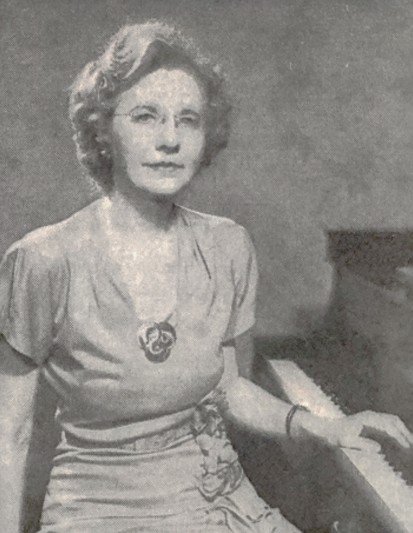
Portrait of Vivien Bard in the 1940s, from April 15, 1952, THCTCSO concert program.
Vivien Bard’s last appearance with the THSO as performer and composer came in 1952, when she premiered her second concerto for piano and orchestra, entitled Concerto romantique in G minor. The Terre Haute Tribune reported the following Sunday that “Miss Bard was recalled time and time again by the pleased audience.”
“New Concerto By Vivien Bard Is Music Delight”
The next day the Indiana State Teachers College hosted a dinner in Bard’s honor. A photograph of the dinner appeared in the Terre Haute Tribune.
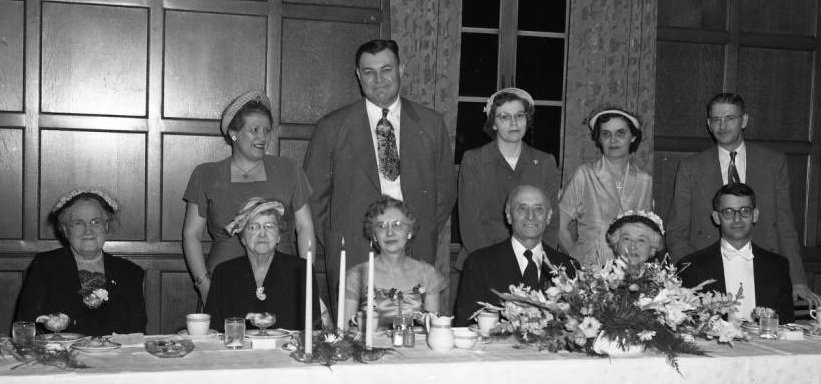
Photograph from April 1952 dinner in honor of Professor Vivien Bard, seated third from the left, beside Indiana State President Ralph Tirey, seated third from the right. THCTCSO conductor Jim Barnes is seated far right. Others in the picture are Indiana State music faculty and their spouses. Courtesy of Indiana State University Special Collections.
No recording or score of Bard’s second Piano Concerto is known to exist.
Bard as Teacher
In December 1952, the THCTCSO announced that it would hold its first-ever Young Artists Contest, the winner of which would appear as a soloist with the orchestra the following March. Contestants were limited to students in first through twelfth grade who lived within sixty miles of Terre Haute. Fourteen young musicians from the Wabash Valley area competed in auditions on Saturday, January 10:
Ersel Burgess (Clinton, Indiana), trombone
Beverly Ann DeLana (Brazil, Indiana), piano
Billy Diekhoff (Terre Haute), tenor
LeAnn Everly (Hymera, Indiana), horn
Ritchie Lynn Griffith (Worthington, Indiana), piano
David N. Kaiserman (Paris, Illinois), piano
Lena Meurer (Terre Haute), horn
Patricia Rains (Hutsonville, Illinois), piano
James Roach (Terre Haute), alto saxophone
Marlene Runyon (Clinton, Indiana), piano
David Sharpe (Terre Haute), piano
Jack Sims (Spencer, Indiana), trumpet
Mark Steiner (Coal City, Indiana), piano
Phillis Weir (Terre Haute), soprano
By the end of the day, 15-year-old David Kaiserman had been declared the winner. The Terre Haute Tribune announced the result the next day, noting that Kaiserman had been taking piano lessons since the age of five, more than half of those years “under Miss Vivien Bard, Terre Haute’s noted pianist-composer.”
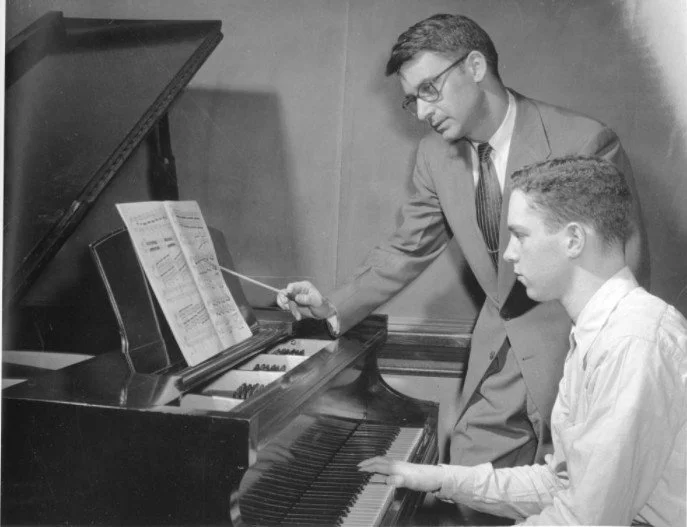
Portrait of THSO conductor James Barnes and pianist David Kaiserman, one of Vivien Bard’s many piano students and winner of the THCTCSO’s first Young Artist Contest in 1953. Courtesy of Indiana State University Special Collections.
Young Kaiserman fully embraced the Beethovenian and Lisztian musical mantle he inherited from Bard. He studied with Bard for a total of seven years before entering New York’s Juilliard School in 1954, where he received multiple scholarships and prizes and eventually graduated with bachelor’s and master’s degrees. He later received a doctorate from the University of Iowa and performed recitals and held faculty positions around the country until he landed in northern Illinois as professor and chair of the Piano Department at Northwestern University. Many middle-aged musicians on the scene today list Kaiserman himself as their teacher… and so the musical generations continue. Dr. Kaiserman’s professional career as a pianist was spectacular, and its earliest stages took place in a piano studio on Center Street in Farrington’s Grove and on a concert hall stage with the THSO. Bard later described him “as one of my best pupils.”
Professor Bard retired from both the THSOA Board of Directors and from Indiana State Teachers College in the early 1960s, but continued to teach private lessons for twenty more years. She lived in her family home on Center Street until her death on November 30, 1985. She is buried with her parents in Roselawn Cemetery north of town.
There was a brief time in the middle 20th century when the name “Vivien Bard” appeared alongside others such as Paul Dresser and Hoagy Carmichael as Indiana composers of note. Today she is mostly remembered for “A Toast to Old DePauw” and for her lifelong work with the sororities in which she was a member.
Vivien Bard is an example of the steady and determined work required to sustain the arts in a town like Terre Haute. Flashy and famous figures in big and far-away cities always receive the most attention; meanwhile, the vital work of music in our own community continues, too often unnoticed. The artistic practices and institutions closest to us depend on the quiet but dedicated work of teachers, professors, sponsors, board members, ushers, audience members, and more.
Terre Haute needed, and still needs, people like Vivien Bard, willing to invest time, energy, and an earnest belief in our city’s cultural life. The history of the Terre Haute Symphony Orchestra and the biography of Vivien Bard show us how much the arts depend on individuals who choose to sustain it. That reality has not changed… and likely never will.
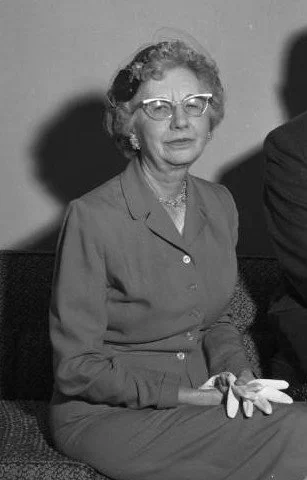
Portrait of Vivien Bard from 1961, on the occasion of her retirement from Indiana State. Courtesy of Indiana State University Special Collections.

If you enjoyed this post, consider supporting your hometown symphony with $100 for #THSO100 — a C-note for a Century!
Click here to donate.
Sources:
“Vivian Bard Writes Music for DePauw’s New Football Song,” DePauw Daily, October 11, 1915, page 1.
“Miss Bard Wins Prize,” Brazil Times, October 13, 1915, page 5.
“Distribution of ‘Yea DePauw’ Mon,” October 23, 1915, page 3.
“American Conservatory of Music,” High School Life, April 1918, page 492.
“Arthur Olaf Andersen Presents His Composition Class,” Music News, April 12, 1918, page 13.
“American Conservatory,” Music News, April 26, 1918, page 39.
“The American Conservatory Presents Artist Pupils of Heniot Levy,” Music News, May 16, 1917, page 10.
“Master Class of Josef Lhevinne at the American Conservatory, Chicago,” The Music News, August 26, 1921, page 13.
“Master Class of Josef Lhevinne at the American Conservatory, Chicago,” Musical Courier, August 25, 1921, page 12.
“American Conservatory Artist Pupils’ Recital,” Musical Courier, July 26, 1923, page 5.
“Gives Chopin Recital in Home City,” The Eagle [Chadron, Neb.], February 1, 1927, page 4.
“Bryant to Conduct Symphony Concert,” Terre Haute Saturday Spectator, January 28, 1928, page 28.
“Vivian [sic] Bard,” The Pan Pipes of Sigma Alpha Iota 20, no. 1 (November 1928): page 108.
“Vivien Bard, Alpha,” The Lyre of Alpha Chi Omega 33, no. 1 (October 1929): pages 72-73.
“The Symphony,” Terre Haute Saturday Spectator, March 3, 1934, page 10.
“Terre Haute Symphony Orchestra,” Terre Haute Saturday Spectator, March 11, 1939, page 9.
“Terre Haute Pianist Playing New Concerto Tuesday Evening,” Terre Haute Tribune, April 13, 1952, page 40.
“Final Symphony Concert This Evening to Feature Vivien Bard, Local Pianist,” Terre Haute Tribune, April 15, 1952, page 11.
“15-Year-Old Paris Pianist Wins Symphony Soloist Honor,” Terre Haute Tribune, January 11, 1953, page 19.
“ISC Faculty Tea May 18 Honors 2 Retiring Members,” Terre Haute Tribune, May 14, 1961, page 2.
“Services Today for Composer Vivien N. Bard,” Indianapolis Star, December 4, 1985, page 62.