
THSO in the Great Depression, Part 1 (1927-1933)
David Chapman | March 20, 2026 | history@thso.org

Photograph of the Terre Haute Symphony Orchestra, at its first-anniversary concert in the Indiana Theatre, January 28, 1928. Courtesy of Indiana State University Special Collections.
In celebratory times — anniversaries, periods of growth, and so on — an orchestra’s health and longevity might seem inevitable. To those working tirelessly within it, however, surviving is never guaranteed, much less thriving. The perseverance of the Terre Haute Symphony Orchestra in its first decade testifies to the vision and creativity of its leaders, as well as the importance of strategic partnerships with its community.
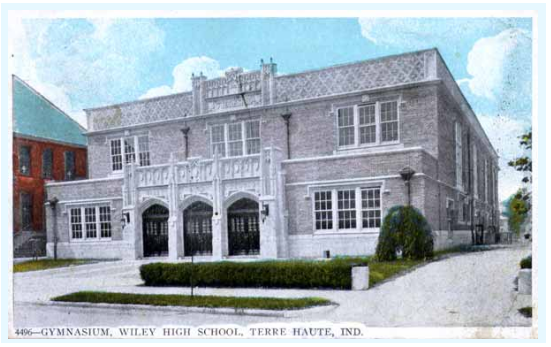
After its inaugural concert in December 1926, the rest of the Terre Haute Symphony Orchestra’s first season wasn’t as well documented. Newspapers indicated that the orchestra performed several more times over the coming months: at St. Mary-of-the-Woods on December 14, 1926; in Indiana State’s Normal Hall on February 23, 1927; at the Brazil Elks lodge on April 6, 1927; and a children’s concert at the Wiley High School gymnasium on May 26, 1927. Other concerts were hinted at, but few specifics were provided and little else is known about them. The first season ended rather quietly, though not permanently.
Source: Wikipedia.
One particularly fascinating article from that first season provides a glimpse of the local music ecosystem in which the THSO operated. A headline in the April 1, 1927, Star announced that “All Terre Haute Orchestras Are to Play at Annual Ball,” held at the Trianon pavilion. The THSO was expected to open the festivities on Friday evening, April 22, 1927, and the next morning the event would feature the following groups:
Ken Davis’ Wabash Serenaders
Harry Johnson’s Orchestra
L.S. Amour’s Orchestra of Marlatt’s Dancing School
Jack O’Grady’s Varsity Entertainers of the Grand Theater
Art Worman’s Orchestra
Warren Lucas’ Indiana Theater Orchestra
Paul Johnson’s American Theater Orchestra
Leo Baxter’s Liberty Boys’ Orchestra
Bud Cromwell’s Kings of Rhythm
It is not known whether the THSO actually performed at this event, but the announcement alone is still instructive. Then as now, musicians often performed in multiple organizations and were always on the lookout for more “gigs.” Warren Lucas and Jack O’Grady, for example, were not only directors of ensembles listed above but also performers in the Terre Haute Symphony. The personnel of any two of these groups likely overlapped each other by at least a handful of performers. The music world in cities of all sizes is always small, and smaller still in small towns.
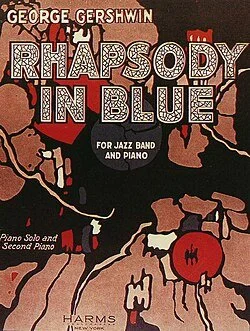
Cover of the original sheet music to Rhapsody in Blue, 1924. Source: Wikipedia.
What Bryant’s THSO provided that all these did not was a focus on so-called “good music” — that is, the European classical repertoire. Popular music was inexpensive and everywhere at this time, not only in dance halls and theaters but also in people’s homes thanks to sheet music, phonographs, player pianos, and a newfangled technology called radio. Many musicians and educators at that time, even ones whose main livelihood was playing in dance and theater bands, felt they had a duty to defend “good music” against the everyday tastes of average listeners.
“Jazz Symphony Just a Fad, Says Musician”
The offense of popular music was less an active attack than a threat of passive neglect. Classical musicians needed to convince audiences that they could enjoy as much or more in the concert hall as in the dance hall. The world of classical music was still reckoning with the Jazz Age and commentators argued over the relative merits of popular and classical music. George Gershwin’s now-famous jazz-and-classical concert experiment Rhapsody in Blue had premiered only a couple of years before and had not yet achieved the legendary and respectable status it enjoys today. His opera Porgy and Bess (1935) was still almost a decade away in the future!
“[Composer John Alden Carpenter] Says Jazz Opera Will Never Be Produced”
The THSO’s second (1927–1928) and third seasons (1928–1929) resembled its first in many respects. Its fruitful partnership with the Woman’s Department Club continued with performances at the Indiana Theatre on the club’s annual Guest Day. Both of these anniversary concerts — held on January 28, 1928, and January 26, 1929, respectively — featured talented local musicians: pianist Vivien Bard performing a Liszt concerto at the first, and soprano Elsa Silverstein singing an aria from Charpentier’s Louise at the second. (Both these women would later serve as members and officers of the symphony’s Board of Directors.)
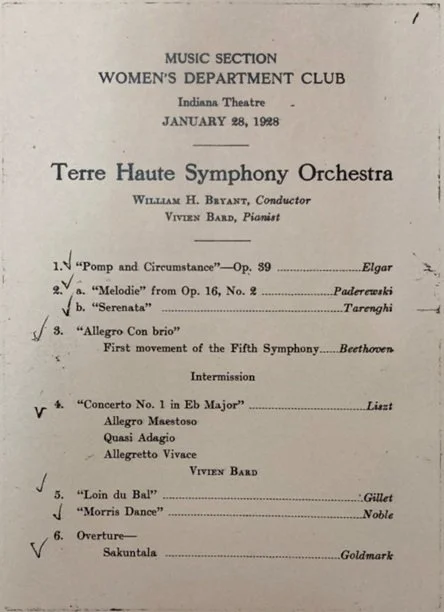
A photocopy of the oldest known THSO program, from the first anniversary concert, January 28, 1928; from internal THSO archives.
In those early seasons, variety characterized both the music the THSO played and the venues they played in, including the Shrine Temple, First Congregational Church, the gymnasium in Indiana State’s Women’s Physical Education building, and others. Each season ended with a performance at the college’s May Music Festival.
“T. H. Symphony Orchestra [...] on Program for [Clark] Sesquicentennial at Vincennes Feb. 25 and 26”
In February 1929, the orchestra was invited to travel south to Vincennes to perform for a major festival commemorating the sesquicentennial of the British surrender at Fort Sackville. Community leaders in Vincennes had heard glowing reports of the THSO’s concerts and urged the planning committee to engage them for the festival. The sesquicentennial event was part of a years-long effort to bring national attention to Vincennes and its history, which included a special stamp by the U.S. Postal Service and a federal commission to create the Clark Memorial monument. The two-night late-winter festival featured concerts by the THSO and the Purdue military band, a large community dance, appearances by prominent politicians and celebrities, and a reenactment pageant featuring 500 performers. President Coolidge was personally invited by a close Hoosier friend, but declined and sent his regrets. It was a major compliment for the still-new THSO to be asked to participate in the festival, even if only twenty of its musicians made the trip. It must have seemed that all of Indiana and the Midwest — perhaps even the whole country! — were hearing about the Terre Haute Symphony Orchestra!
A Period of Crisis Begins
However, the next few years would cast doubt on whether the THSO would survive to see its tenth or twentieth anniversaries, much less its hundredth. Even in good times, as the 1920s seem to be in hindsight, orchestras are a delicate enterprise. Many musicians and audiences love classical music because of its depth and gravity, but others prefer simpler pleasures and lighter entertainment. And, as is clear from the list of orchestras above, such things could easily be found in a dozen other places around town. This competition for audience attention and support had especially intensified after the advent of sound films — talkies! — in 1927, which had spelled doom for theater orchestras and traveling shows within several short years. Hometown newspapers regularly published multiple full-page advertisements for the newest radio programs and motion picture releases, while the THSO could count on only infrequent, short, and often anonymously written articles in the “women’s interest” sections of the paper.
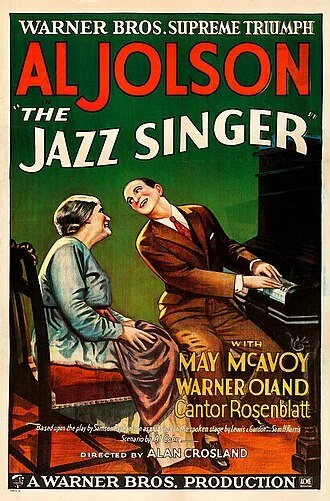
Poster for the 1927 film The Jazz Singer starring Al Jolson, the first feature-length motion picture with synchronized sound, including recorded music and dialogue. Source: Wikipedia.
“The institution of the talkies affected the musicians union, and whereas it formerly had a membership of 275 it now numbers about 175.”
Another challenge emerged in the summer of 1929. An article in the June 1 Saturday Spectator indicated that Bryant would be taking a leave of absence from his post at Indiana State until the following February. The reason for his temporary departure was officially due to poor health, but the article’s unnamed author speculated that it might also have been related to a union dispute. Students at Indiana State had recently refused to employ union stagehands in the production of a play, causing the college to be placed on the “unfair list” and requiring members of the musicians’ union to respond in solidarity. The article reported that Bryant had been ordered by the union to choose whether to stand down from his position at the college or to surrender his union membership. Friends of Bryant insisted that his leave of absence was necessary for his health alone and that, had it been otherwise, he would have chosen his university work over the union. It is unclear what effect, if any, this leave of absence had on the orchestra in real terms, because it would soon be overshadowed by other historical events.
“Report Denied That Musicians’ Union Had Made Trouble With W. H. Bryant and State College”
Then, in Autumn 1929, several extraordinary disruptions in the U.S. and world economies marked the onset of what would become known as the Great Depression. In late October, stock markets experienced a series of devastating crashes, crippling businesses in cities across the country. Then, in summer 1930, the multi-year environmental catastrophe known as the Dust Bowl began, pushing rural farming communities to collapse. The banking system buckled under a wave of loan defaults, compounded by depositors rushing to withdraw their savings before they disappeared. Unemployment and homelessness spiked. Small communities became ghost towns as millions of Americans became migrant refugees within their own country, looking for hope and opportunity anywhere it might be found.
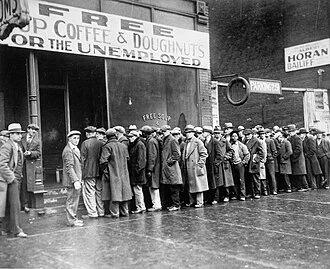
Unemployed people lined up outside a soup kitchen opened in Chicago by Al Capone, February 1931. Source: Wikipedia.
Musicians and artists around the country faced many of the same challenges as workers in other industries. But sustaining the arts becomes especially hard during extreme crisis. It is perhaps no surprise, then, that the THSO largely disappeared from the public record during the years 1930 to 1933, with no direct evidence of any activity by the orchestra in what would have been its fourth (1929–1930) through its seventh (1932–1933) seasons.
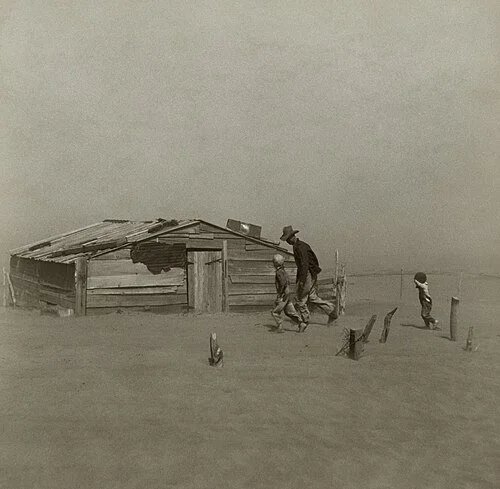
Arthur Rothstein's Farmer and Sons Walking in the Face of a Dust Storm, a Resettlement Administration photograph taken in Cimarron County, Oklahoma, in April 1936. Source: Wikipedia.
This absence of evidence, however, is not evidence of absence. What looks like disappearance in local newspaper coverage may have been strategic. There is subtle evidence that the orchestra quietly survived behind the scenes, and that the blended interests of the college and the community were key to its survival. In 1932 and 1933, the imminent American pianist and composer Percy Grainger visited Indiana State’s campus to perform in two special concerts with Bryant on the podium. To accompany Grainger, local newspapers reported that Bryant had assembled an orchestra of eighty musicians made up of his student ensemble augmented with performers from the surrounding region. Indiana State catalogs from the time indicate that, even in non-depressed times, the student orchestra numbered only about 25, far short of the 85 number; by contrast, the THSO had reached more than 60 at its pre-Depression peak.
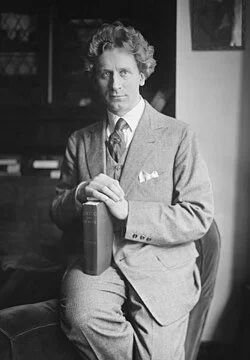
Percy Grainger, Australian-American composer and pianist, photographed in 1915. Source: Wikipedia.
After his visits, Grainger was effusive in his praise for Bryant and his ensemble: “Prof. Bryant is an intuitive leader, as indicated by the performance of the wonderful orchestra he had gathered together and trained to such a high degree of perfection.” Furthermore, he insisted that “there is no call for the people of Terre Haute to visit other cities to enjoy the performance of symphony orchestras when they had such a splendid organization.” Note the civic rather than collegiate orientation of Grainger’s comment. An orchestra of more than eighty suggests that Bryant may have consolidated his college and civic orchestras and their overlapping personnel into one. Given the documented sizes of Bryant’s orchestras and known personnel overlaps between them, it is reasonable to conclude that these were the same musicians who in better times performed together as the Terre Haute Symphony Orchestra. In effect, the THSO survived by disappearing.
“Percy Grainger Pays High Tribute to Prof. Bryant, Says He is Wonderful Leader of Splendid Orchestra”
The story of the THSO’s survival during the Great Depression continues in two weeks! Stay tuned…


If you enjoyed this post, consider supporting your hometown symphony with $100 for #THSO100 — a C-note for a Century!
Click here to donate.
Sources on the first season after the inaugural concert (1926-1927):
[Untitled article], Terre Haute Saturday Spectator, January 15, 1927, page 24.
“Music Box,” Terre Haute Saturday Spectator, February 19, 1927, page 15.
Morton Leath, “Local Symphony Orchestra Presents Pleasing Program,” Terre Haute Star, February 24, 1927, page 14.
[Untitled article], Brazil Daily Times, April 6, 1927, page 1.
“All Terre Haute Orchestras Are to Play at Annual Ball,” Terre Haute Star, April 1, 1927, page 16.
[Untitled article], Terre Haute Spectator, May 14, 1927, page 26.
Sources on the second season (1927-1928):
[Untitled article], Indianapolis Star, October 9, 1927, page 63.
[Untitled article], Terre Haute Saturday Spectator, November 12, 1927, page 10.
“Music Box,” Terre Haute Saturday Spectator, Deember 31, 1927, page 19.
[Untitled article], Terre Haute Saturday Spectator, January 7, 1928, page 27.
[Untitled article], Terre Haute Saturday Spectator, January 14, 1928, page 23.
[Untitled article], Terre Haute Saturday Spectator, January 21, 1928, page 10.
“Bryant to Conduct Symphony Concert,” Terre Haute Saturday Spectator, January 28, 1928, page 28.
[Letters to the editor], Terre Haute Saturday Spectator, February 4, 1928, page 23.
“Music Box,” Terre Haute Saturday Spectator, February 4, 1928, page 28.
[Untitled article], Terre Haute Saturday Spectator, March 3, 1928, page 23.
[Untitled article], Terre Haute Saturday Spectator, March 17, 1928, page 10.
“The Symphony Concert,” Terre Haute Saturday Spectator, April 7, 1928, page 30.
Sources on the third season (1928-1929):
[Untitled article], Terre Haute Saturday Spectator, September 1, 1928, page 20.
“Honoring Franz Schubert,” Terre Haute Saturday Spectator, December 1, 1928, page 28.
“Symphony Recital,” Terre Haute Saturday Spectator, December 8, 1928, page 12.
“Schubert’s Unfinished Symphony,” Terre Haute Saturday Spectator, January 19, 1929, page 22.
“Department Club,” Terre Haute Saturday Spectator, January 26, 1929, page 12.
[Letters to the editor]. Terre Haute Saturday Spectator, February 2, 1929, page 6.
[Untitled article], Terre Haute Saturday Spectator, October 27, 1928, page 19.
[Letters to the editor], Terre Haute Saturday Spectator, February 2, 1929, page 6.
“[Letters to the editor], Terre Haute Saturday Spectator, February 16, 1929, page 4.
“Report Denied that Musicians’ Union Had Made Trouble with W. H. Bryant and State College,” Terre Haute Saturday Spectator, June 1, 1929, page 3.
Sources on the Clark Sesquicentennial in Vincennes (1929):
“Issue Call for 500 to Help in Clark Pageant,” Vincennes Sun-Commercial, page 1.
“Call for Clark Players Issued,” Evansville Press, February 7, 1929, page 3.
“Seek 500 for Cast of Clark Pageant,” Indianapolis Star, February 8, 1929, page 20.
“Vincennes Calls 500 for Pageant,” Evansville Courier and Press, February 8, 1929, page 26.
“T.H. Symphony Orchestra, Jack O’Grady on Program for Sesquicentennial at Vincennes Feb. 25 and 26,” Terre Haute Saturday Spectator, February 9, 1929, page 3.
“Many from Terre Haute Will Attend Exercises Observing Anniversary of Ft. Sackville Surrender,” Terre Haute Saturday Spectator, February 23, 1929, page 4.
[Untitled article], Terre Haute Tribune, February 23, 1929, page 4.
Kate Milner Rabb, “Citizens of Old Northwest Territory Pay Tribune to Clark the Conqueror, Indianapolis Star, February 26, 1929, page 1 and 7.
“Scenes at Clark Celebration at Vincennes,” Indianapolis Star, February 26, 1929, page 13.
Sources on Percy Grainger’s visits in 1932 and 1933:
“Percy Grainger to Come,” Terre Haute Saturday Spectator, February 6, 1932, page 10.
“Percy Grainger,” Terre Haute Saturday Spectator, March 19, 1932, page 13.
“Percy Grainger Pays High Tribute to Prof. Bryant, Says He is Wonderful Leader of Splendid Orchestra,” Terre Haute Saturday Spectator, March 26, 1932, page 6.
[Letters to the editor], Terre Haute Saturday Spectator, page 6 and 9.
[Untitled article], Terre Haute Saturday Spectator, April 15, 1933, page 8.
“Percy Grainger Concert May 4,” Terre Haute Saturday Spectator, April 28, 1933, page 9.