
Carl Eppert and His THSO (1903-1907)
David Chapman | March 6, 2026 | history@thso.org
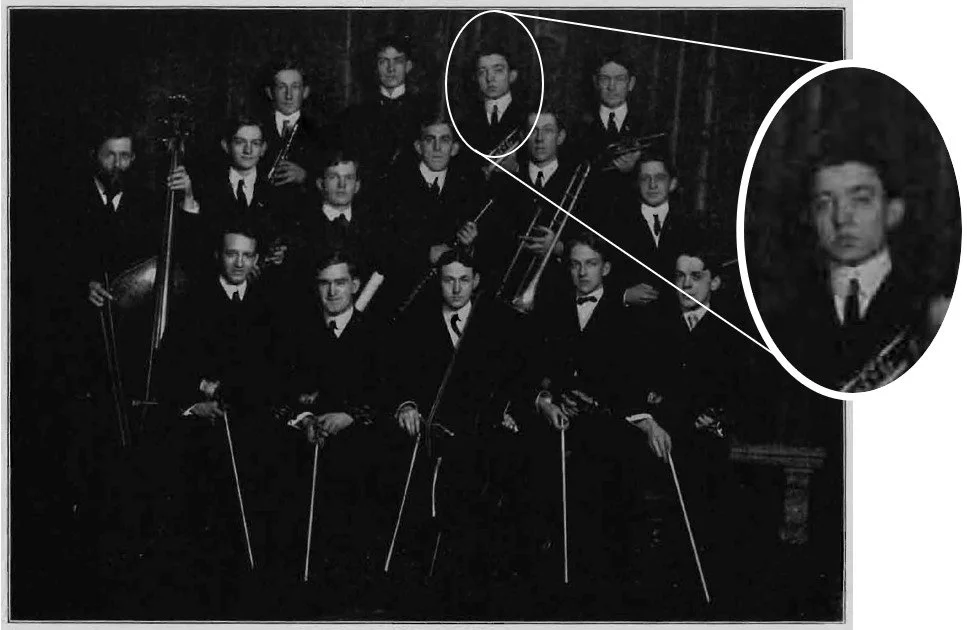
Carl Eppert as cornettist in the Rose Polytechnic Orchestra, photo published in the Rose Polytechnic Institute’s Modulus yearbook, 1905
The Terre Haute Symphony Orchestra that we know and love today was not the first THSO!
For four seasons, from 1903 to 1907, a Terre Haute Symphony Orchestra regularly rehearsed and performed under the leadership of an enterprising young conductor and aspiring composer named Carl Eppert.
First season, 1903-1904:
When 1904 began, Carl Ellis Eppert was a 21-year-old college sophomore majoring in Mechanical Engineering at Rose Polytechnic Institute, with personal passions for chess and the cornet. The Eppert family were members of Terre Haute’s large and longstanding German-American community, with ties to the area going back several generations on both his father William’s and his mother Ida (Stephenson)’s sides. His father was a local coal industry executive, with interests in mining corporations throughout the region. This afforded young Carl and his six younger siblings many of the conventional benefits of an upper middle-class life: excellent educations, guaranteed jobs, and — for Carl, anyway — the means to pursue music at the highest levels. The Epperts were also generous and community-minded, contributing substantially to local charitable institutions that are still active in Terre Haute today, including the Y.M.C.A. and the Light House Mission.
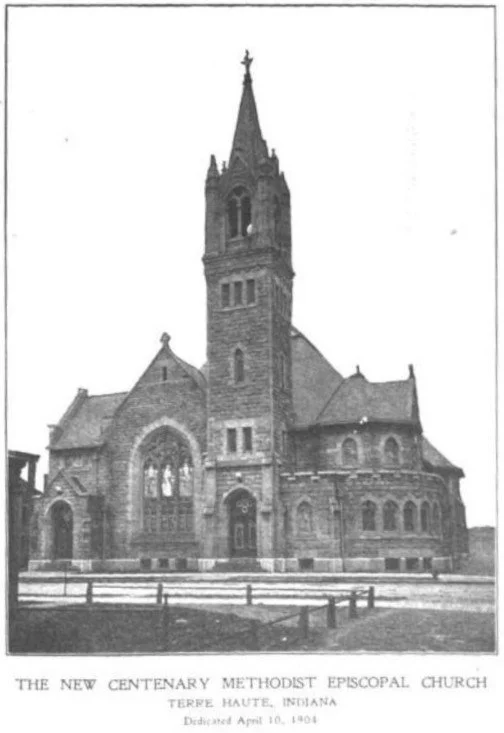
Photo published in The Christian Advocate, April 21, 1904
Carl and his family were members and lay leaders of Terre Haute’s Centenary Methodist Episcopal Church and some of the earliest public notices of Carl’s musical talents appeared in connection with the church and its regional denomination. It was at the Centenary Church at 7th and Eagle that Eppert’s THSO first performed. The church’s building had suffered a devastating fire in the 1880s and a long reconstruction project was finally reaching completion in early 1904. In the week after Easter Sunday, Centenary held a three-evening music festival to dedicate the newly rebuilt and expanded facilities. After several months of rehearsals, the festival opened on Monday, April 4, 1904, with Carl Eppert leading a performing force of 38 instrumentalists and five singers. The Terre Haute Evening Gazette covered the event the next day and from that review we know a bit about what took place.
The orchestra — which did not yet have a name — opened with the famous Wedding March from Felix Mendelssohn’s A Midsummer Night’s Dream, and they performed crowd-pleasing selections from favorite operas of the time, including the “Toreador Song” from Bizet’s Carmen and the Act III quintet from Flotow’s Martha. Of particular note was the “Miserere” scene from Verdi’s Il trovatore, in which the singers staged themselves around the auditorium, singing from the chancel, the organ loft, and the foyer as they reenacted the famous tower scene. (The organ in the loft, as it happens, had been gifted to the church by the Eppert family.) The Verdi excerpt was such a hit that after it was over the audience would not stop their cheering until the musicians agreed to repeat it. The venue and the performers left such a profound impression on all present that, at the end of the concert, no one dared to leave right away. The Gazette noted the achievement in its review: “The programs for the opening night said ‘Grand Vocal and Instrumental Concert.’ This was not an exaggerated statement. It was a grand concert.”
“Mr. Carl E. Eppert astonished people by the splendid organization he has effected with his symphony orchestra and in his masterful leadership.”
The dedicatory concert was repeated on May 23, 1904, and expanded with several additional compositions, prompting local musician Carrie Adams to comment in the Saturday Spectator on the city’s need for a symphony orchestra:
The repetition of the fine program given by the Symphony Orchestra and Centenary Quartette [the church’s regionally famous four-voice choir] during the week of dedicatory services at Centenary last Monday night gave pleasure to a discriminating audience containing all of the good features of the original program and some new ones of equal interest. A permanent orchestra made up of young people would be of untold benefit to the on-coming musical generation in Terre Haute, in that ensemble playing is the only highway to the great things in music. Artists of renown have achieved much of their skill and breadth of culture through early association with other musical aspirants in orchestral work in the amateur orchestra directed one of their own number. Certainly there are a sufficient number of young people anxious to form a permanent organization here to make the move a successful one, and it is hoped that steps are being taken in that direction.
Adams would soon become the orchestra’s main champion in the local press, advocating for the fledging ensemble and its director in her music columns in the Spectator. But it was the Terre Haute Evening Gazette that had the honor of reporting the orchestra’s new name on May 24, the day after its second concert: “The Terre Haute Symphony Orchestra with Mr. Carl Eppert as leader assisted by Centenary choir scored another success […] .” The first season was an auspicious beginning, both for Carl Eppert and for the newly named THSO!
Second season, 1904-1905:
As it is for so many young people in their early twenties, these were transitional years for Eppert. After completing several terms at Rose Poly, he withdrew from college and went to work as a secretary at his father’s coal mine, the Eureka Block Coal Company. In late September 1904, he married Virginia Fern Casto, the daughter of local physician Dr. Jabez Casto, and the following August they welcomed their first child — Carl Jr. — to their home at 1311 South Center Street. In his spare time Eppert worked to grow and sustain his new orchestra.
Now that the THSO existed, the next challenge was to build support and make it permanent. Indiana State Normal School began offering academic credit for performing in the THSO. In January 1905, Adams wrote: “An envelope bearing the instruction ‘Carl Ellis Eppert, Director Terre Haute Symphony Orchestra,’ chanced to arrive one day and investigation showed a full-fledged orchestra of thirty-one bright capable musical enthusiasts, all young, all students and all players of more than ordinary amateur skill. If ever a city needed such an organization, this is the city.”
“The musical hope of the city lies with these young students whose youth and earnestness will carry the work to success and whose young director will keep the standard high...”
The THSO performed the opening concert of its second season at Centenary Church on March 28, 1905. In a preview, Adams again noted the youthfulness of the director and the orchestra’s members, and expressed her hope that the organization would become an enduring fixture of the city: “In looking over the list of members one is struck with the youthfulness of its make-up and encouraged to believe there is really a growing sentiment in favor of good music when the program is considered. It is an unusually hopeful sign when so many young people are working together for the sake of presenting in an artistic manner such compositions as their program includes. […] With a church full of interested listeners to encourage them in their work there is no doubt but that a permanent organization will be maintained.”
The program opened with the overture to Rossini’s L'italiana in Algeri, and included a reprise of the “Toreador Song” from Carmen. The concert closed with the Grand March from Act II, Scene 4 of Tannhäuser and, after the audience demanded an encore, Eppert and the THSO performed an orchestral arrangement of one of Felix Mendelssohn’s “Songs Without Words.” The Terre Haute Star reported the next day that “every number was applauded to the echo.”
The THSO closed its second season at the Grand Opera House on May 12, 1905, its first concert outside of Centenary Church. Adams once again promoted the concert in the Spectator with an exhortation to the town’s ticket-buyers: “All the Symphony Orchestra needs as a stimulus to further activity and permanent organization is the hearty applause and appreciation of an opera house full of home people. Their efforts are worth it and would indeed be strange if Terre Haute should fail to encourage them when everybody is on the high tide of musical enthusiasm.” The day after, the Terre Haute Star assessed that “nothing that can compare with the work of the Terre Haute Symphony Orchestra has ever been known in Terre Haute. To appreciate the character of this musical organization it is necessary to hear it.”
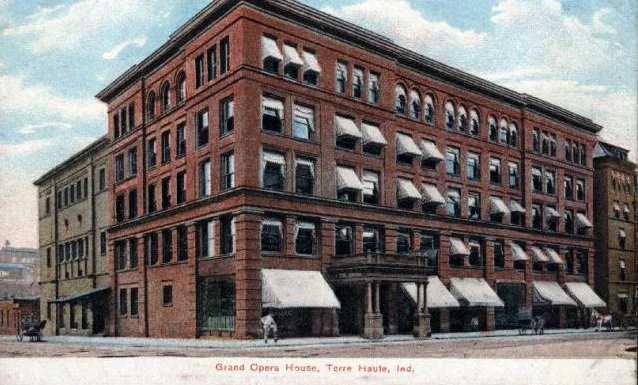
Source: Vigo County Community Collection, Vigo County Public Library
Third season, 1905-1906:
Carl Eppert’s long-term musical ambitions included being not only a conductor but also a composer. Having spent two years leading the THSO, and even longer as a practicing musician, his compositional aspirations found their first fruit in late 1905. His earliest known composition is dated October of that year and is entitled “Melody in E minor” for solo piano. The work was never published and seems to exist only as a manuscript in the composer’s archived papers at the University of Wisconsin—Milwaukee. But despite its obscurity, “Melody in E minor” was an early glimpse of Eppert’s future career as an American composer of note.

Source: Vigo County Community Collection, Vigo County Public Library
The opening THSO concert of the third season took place on January 12, 1906, at the old First Baptist Church at 6th and Walnut. It was presented as part of the “Peoples’ Lecture and Entertainment Course,” which included presentations by politicians, lecturers, magicians, and musicians. Although the program for this concert is unknown, the Star noted the next day that the concert had been “enjoyed by a large audience.”
A second concert for the home crowd in Terre Haute was held at the Grand Opera House on March 7, 1906. This event received substantial coverage by the local press. As usual, Adams previewed the concert in the Spectator, with typically effusive language: “The popularity of this instrumental musical organization, the best of its kind Terre Haute has ever known, is steadily growing as the people come to understand it is an institution well worthy of encouragement and support.” The Spectator and the Star both provided readers with a list of the planned program in advance, which included a movement from Schubert’s “Unfinished” Symphony, two of Brahms’ Hungarian Dances, and the overture to Rossini’s Semiramide. Several of the works in this program were popular solo piano pieces, such as Luigi Arditi’s Forosetta and Tchaikovsky’s “Song Without Words,” op. 2, no. 3, so it is plausible that these may have been orchestrations by Eppert himself. The Star reported on the concert’s final rehearsal in one article, reviewed the concert itself in a second article, and even documented a dinner reception held afterward in a third! It was perhaps the high point for Eppert’s THSO, and it set new expectations for the orchestra in the future.
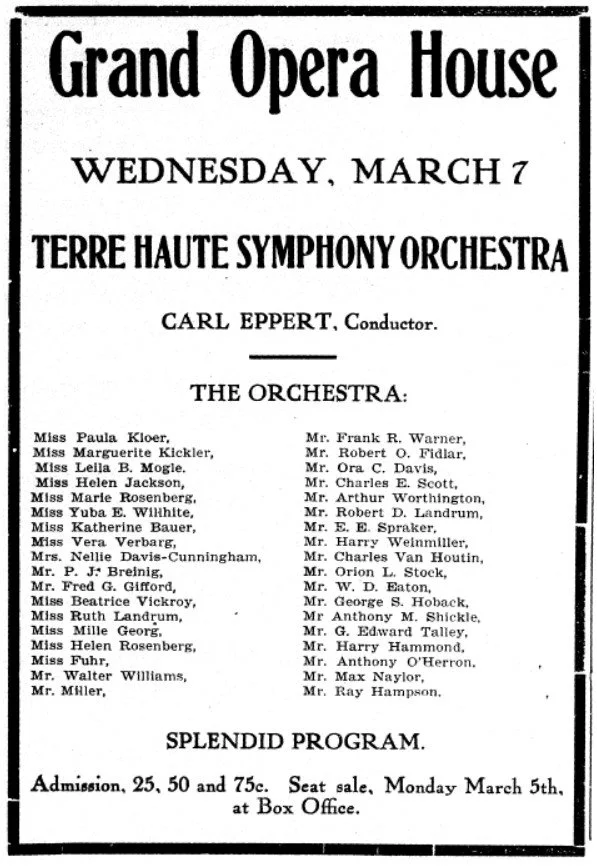
Advertisement from Terre Haute Saturday Spectator, March 3, 1906
The THSO performed its first “runout” concert in Paris, Illinois, on April 28, 1906. The event was hosted by the Paris Elks and held at Shoaff’s Opera House. Ten days before, the biggest news in the country had been the massive earthquake in San Francisco. At the end of the month, newspapers around the U.S. and the world were still reporting fires throughout the city, with thousands of people missing and feared dead. Notices for the Paris THSO concert indicated that the Elks would “give their part of the proceeds to the San Francisco sufferers.”
(There are some indications that another concert may have been held in late May 1906, but little firm historical evidence has been found to support this. Further research is required to verify.)
Fourth season, 1906-1907:
Despite valiant efforts to secure the THSO permanently, the fourth season of Eppert’s THSO would be its last. Few could have known this when the season began. The orchestra performed another runout concert at Shoaff’s Opera House in Paris, Illinois, on January 16, 1907, hosted once again by the Paris Elks. A few weeks later, the THSO opened its two-concert season at home with a performance at the Grand Opera House on February 25, 1907. The Saturday Spectator ran its regular preview with full lists of performing personnel and programmed works. The concert featured the Sailor Chorus from Act 3 of The Flying Dutchman, two Spanish dances and a serenade by Moritz Moszkowski, and the overture to Suppe’s Poet and Peasant. Of particular note were several compositions and arrangements credited to Eppert himself: an orchestration of Bohm’s Intermezzo and the Wolf’s Glen scene from Weber’s Der Freischutz, as well as three originals songs by Eppert and sung by guest tenor Harry Mercer.
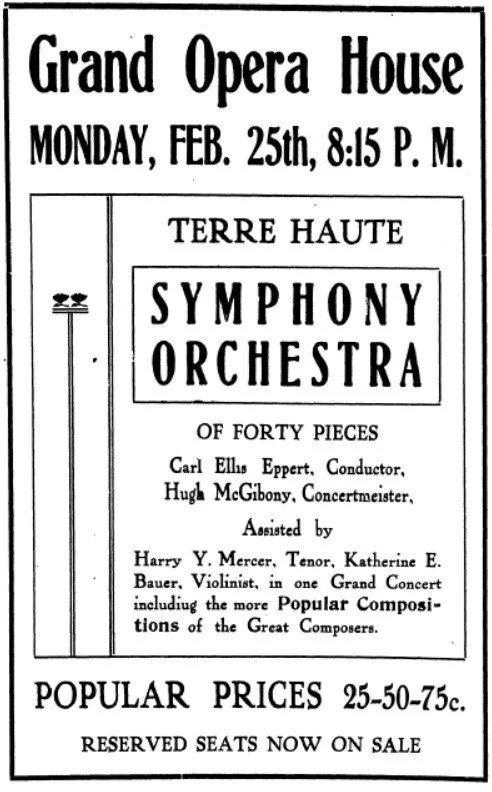
Advertisement from Terre Haute Saturday Spectator, February 23, 1907
Although the program was well received, the unnamed writer who reviewed the concert in the Spectator (presumably Carrie Adams) was clearly disappointed by the city’s insufficient interest in its orchestra:
Terre Haute, satiated with comic opera, filled with clap trap and senseless doggerel of vaudeville and flushed with frothy exhileration of burlesque comedy, passed up one of the best opportunities of the season last Monday evening when it failed to pack the Grand opera house for the first concert this season of the Terre Haute Symphony Orchestra […] The excellence of the program, the skill with which it was presented, and the support Terre Haute ought to bring to the symphony organization should have exhausted the box office. As it was, it was a very small audience that heard the delightful number.
It is a lament familiar to classical music enthusiasts throughout the 20th and 21st centuries, akin to “kids these days, with their rock-and-roll and short attention spans!” But it was also an early indication that the THSO in its fourth season was not enjoying the success it had hoped for, despite the valiant efforts of so many.
The fourth season came to a close at the Grand Opera House on May 3, 1907. The THSO, having grown in strength to 45 musicians, performed Rossini’s famous William Tell overture, the “Solumn Procession” from Act I, Scene 2, of Wagner’s Parsifal, and Weber’s Konzertstück for piano and orchestra. But there was a hint in the Spectator preview that this might indeed be the last concert: “The management has stated that the future of the organization depends much on the attendance at this appearance, and Terre Haute should see to it that such an organization should not be permitted, through lack of proper patronage, to discontinue its work. From the standpoint of the music lover, the house ought to be packed.”
It now seems clear that these hopes were not met. Within a few weeks Eppert had made plans to close the symphony and pursue further music education abroad. In late May, the Spectator announced that “Mr. Eppert and wife sail in August for Leipsic [Leipzig] to make their home. Mr. Eppert will study music. They have offered their furniture for sale.” Eppert would join a community of American expats in Berlin while studying composition with Hugo Kaun and conducting and orchestration with Arthur Nikisch and Ernst Kunwald. Germany was not yet the grand villain that it would become in two World Wars over the next several decades. In 1907, it was still the center of the European classical music universe.
On August 1, the young Eppert family left Terre Haute for New York City, where they boarded a transatlantic ship bound for Germany. On August 30, the St. Louis Globe-Democrat declared that the THSO conductor’s next chapter had begun: “Carl Eppert, son of W. E. Eppert, coal operator, has arrived in Berlin, where he will spend four years in the study of orchestral music. He organized the Terre Haute Symphony Orchestra with volunteer amateurs.” He was still only 25 years old.
Postscript:
This first chapter — a prologue, really, both for the THSO and for Carl Eppert — had closed and their stories diverged. Over the next six years, Eppert pursued his conducting and composing studies and took on students and performing gigs of his own. By the time he completed his Berlin residency, he had several dozen new compositions on his personal works list. When war broke out in 1914, Eppert returned to the U.S. with his family, which now included a second son named John. After a few months in Los Angeles, they settled in Washington state, where Eppert took conducting jobs at the Seattle Grand Opera and later at the Spokane Symphony. *
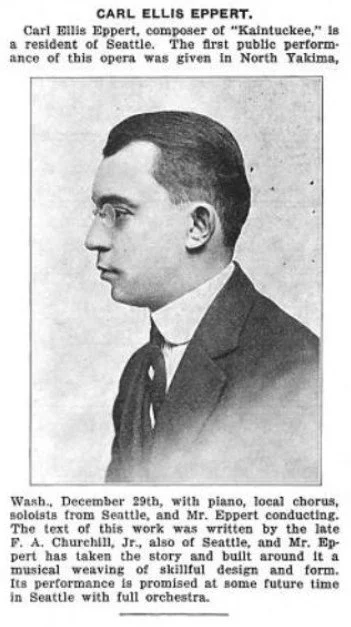
Published in Music and Musicians, January 1917.
In the early 1920s Eppert returned to the Midwest, serving for several years as dean at the Wisconsin Conservatory of Music. And it seems his fondness for starting orchestras continued as well: several publications credit him with having founded the Milwaukee Civic Orchestra and the Milwaukee Symphony Orchestra, even as a new attempt at a Terre Haute Symphony Orchestra was getting started. * And he continued to write substantial music compositions, some of which won major awards and were performed by opera companies, orchestras, and military bands all over the United States and abroad.
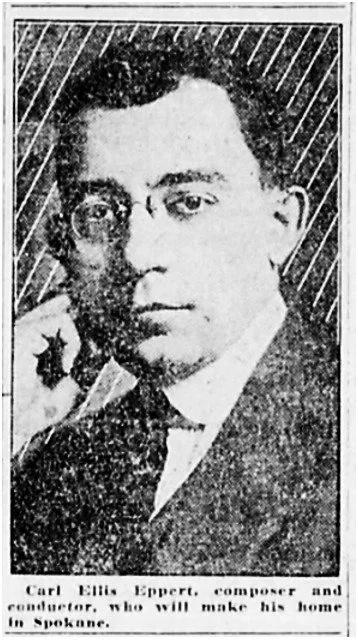
Published in Spokane Chronicle, June 5, 1920
Eppert’s career ascent was followed closely by his former hometown of Terre Haute, where his parents and many of his family members and childhood friends continued to live. The Spectator reported on May 8, 1920, for example: “Friends of Carl Eppert will be pleased to hear of the honor recently conferred upon him in his appointment as director of the Spokane Symphony Orchestra at Spokane, Wash. Mr. Eppert will be especially remember as the director as well as organizer of the Terre Haute Symphony Orchestra, which was such a success here…” On November 16, 1952, the Terre Haute Tribune noted the performance of Eppert’s composition Escapade in Milwaukee: “Carl Eppert is well-remembered by many Terre Hauteans. […] Mr. and Mrs. Eppert were prominent in civic affairs and in the Centenary Methodist church. The present organ in the church was the gift of his parents.” Even his death in 1961 received notice by Terre Haute’s media: both the Tribune and the Star ran stories announcing his funeral and recalling his life and local beginnings.
“Funeral services will be conducted tomorrow in Milwaukee, Wis., for Carl Eppert, 78 years old, internationally known modernist composer. Mr. Eppert, a native of Terre Haute, died Sunday in Milwaukee following a long illness.”
Sadly, Carl Ellis Eppert is not well known today. There are no commercially available recordings of his music. Only one recording of his music exists online: a digitized recording of his 1940 Concerto Grosso on a Philadephia Orchestra radio broadcast from 1961. His papers and compositions sit in the Milwaukee Public Library and the University of Wisconsin—Milwaukee, waiting for someone to rediscover and revive his music!
Eppert must surely have felt some regret at seeing his THSO dreams come to an end in 1907. But the dream of a permanent THSO was not gone forever, only postponed. His THSO was a first iteration of our beloved orchestra, and it too deserves to be remembered and celebrated in this anniversary year of 2026. Carl Eppert’s legacy continues in the Terre Haute Symphony Orchestra today, more than 120 years later!
Quite a legacy for such a young man!

If you enjoyed this post, consider supporting your hometown symphony with $100 for #THSO100 — a C-note for a Century!
Click here to donate.
* Biographical entries in Claire Reis’ 1947 Composers in America and Oscar Thompson and Nicolas Slonimsky’s 1975 International Cyclopedia of Music and Musicians credit Eppert with having led the Seattle Grand Opera, the Spokane Symphony, the Milwaukee Civic Symphony, and the Milwaukee Symphony Orchestra. Not all of these claims align well with available founding and active dates for those organizations. These may be further examples of first iterations of later ensembles — not unlike the Terre Haute Symphony Orchestra! More investigation and research is required to resolve such questions.
Sources on the first season:
“Centenary’s New Church Opened By a Concert,” Terre Haute Evening Gazette, page 7.
“Dedication at Terre Haute,” Northwestern Christian Advocate, April 27, 1904, page 25.
“Program of Concert at Centenary Church,” Terre Haute Evening Gazette, May 21, 1904, page 5.
“Symphony Orchestra Gave Fine Concert,” Terre Haute Evening Gazette, May 24, 1904, page 7.
Carrie B. Adams, “In Musical Circles,” Terre Haute Saturday Spectator, May 28, 1904, page 3.
Sources on the second season:
Carrie B. Adams, “Musical Notes,” Terre Haute Saturday Spectator, January 14, 1905, page 5.
Carrie B. Adams, “Musical Notes,” Terre Haute Saturday Spectator, March 25, 1905, page 9.
“Symphony Orchestra Receives an Ovation,” Terre Haute Morning Star, March 29, 1905, page 7.
Carrie B. Adams, “Musical Notes,” Terre Haute Saturday Spectator, May 6, 1905, page 12.
“Symphony Orchestra,” Terre Haute Morning Star, May 13, 1905, page 7.
Sources on the third season:
“First Symphony Concert,” Terre Haute Morning Star, January 13, 1906, page 6.
“Symphony Orchestra Concert,” Terre Haute Saturday Spectator, March 3, 1906, page 9.
“Fantasma Coming for Three Nights,” Terre Haute Morning Star, March 4, 1906, page 15.
“Final Rehearsal Held,” Terre Haute Morning Star, March 7, 1906, page 3.
“Dinner After Concert,” Terre Haute Morning Star, March 8, 1906, page 4.
“Symphony Orchestra,” Terre Haute Morning Star, March 8, 1906, page 5.
[Untitled article], Terre Haute Saturday Spectator, April 28m 1906, page 8-9.
Sources on the fourth season:
[Untitled article], Terre Haute Saturday Spectator, September 29, 1906, page 9.
“Great Pianists and Singers in Terre Haute,” Musical Courier, January 16, 1907, page 15.
“The Terre Haute Symphony Orchestra Concert,” Terre Haute Saturday Spectator, February 23, 1907, page 17.
“Terre Haute Symphony Orchestra Concert,” Terre Haute Saturday Spectator, March 2, 1907, page 9.
“Second Symphony Concert,” Terre Haute Saturday Spectator, April 6, 1907, page 22.
“Symphony Orchestra Concert,” Terre Haute Saturday Spectator, April 27, 1907, page 7.
Sources on Eppert’s departure from Terre Haute:
[Untitled article], Terre Haute Saturday Spectator, May 25, 1907, page 39.
[Untitled article], Terre Haute Saturday Spectator, August 3, 1907, page 14.
“Crossing the Ocean,” Brooklyn Eagle, August 7, 1907, page 14.
“Indianapolis in Berlin,” Indianapolis News, October 5, 1907, page 22.
Biographies of Carl Ellis Eppert:
Claire R. Reis, “Carl Eppert,” Composers in America, Revised and Enlarged Edition (New York: MacMillan, 1947), pages 113-14.
Oscar Thompson and Nicolas Slonimsky, “Carl Eppert,” The Cyclopedia of Music and Musicians (New York: Dodd, Mead, and Co, 1975), page 649.
Mike McCormick, “Carl Ellis Eppert’s Contributions of Note — Musical and Otherwise,” Terre Haute Tribune-Star, July 14, 2002, [pagination unknown].
Mike McCormick, “Carl Ellis Eppert,” Terre Haute Tribune Star, March 2, 2006, page D4.
Mike McCormick, “Carl Ellis Eppert and the Terre Haute Symphony Orchestra in 1906-07” Terre Haute Tribune-Star, November 6, 2011, [pagination unknown].