
The TH(CTC)SO in WWII (1939-1945)
David Chapman | April 17, 2026 | history@thso.org
NB: The THSO History and Legacy Blog will return in two weeks with our next post on the final years of the Will Bryant era, 1946-1949. There will be no post on Friday April 24.
After surviving the Great Depression and reorganizing for long-term stability, the THSO renamed itself the Terre Haute Civic and Teachers College Symphony Orchestra in 1939 and appeared better poised to endure the challenges of the next decade.
The THCTCSO’s expanded name came with new opportunities as well as new responsibilities. In exchange for the use of school instruments and space to rehearse and perform, the orchestra agreed to provide additional opportunities for student performance and to accompany certain college functions with music. In its 14th season (1939-1940), for example, the orchestra accompanied a Sycamore Players production of Shakespeare’s A Midsummer Night’s Dream, performing Felix Mendelssohn’s famous overture and incidental music for the play.
“Terre Haute Orchestra Affiliated with College”
The THCTCSO was not the only orchestra performing regularly on the campus of Indiana State. Violinist Arthur Hill, one of the original THSO founders and now a colleague of Will Bryant’s in the Indiana State music department, directed the college’s student orchestra. Fellow faculty member Joseph Gremelspacher directed the student band (and became legendary doing so over the next several decades). Both the band and the student orchestra operated independently from the THCTCSO and performed their own seasons of concerts.
But despite that independence, the relationship between them all was very close: they performed in the same spaces and to similar audiences, with considerable overlaps among their musicians. Out of 200 known members of the THCTCSO who performed at various times during these years, about forty were Indiana State students who also performed in the college orchestra or band, or both. The ISTC music programs had grown considerably in the prior decade and the band and orchestra now often rivaled or even surpassed the THCTCSO in size.
How the War affected the THCTCSO
The classical music world had many challenges to reckon with in the first half of the 20th century, but few more vexing than its uncomfortable relationship with Germany. The German-speaking countries were, simply put, the center of orchestral world in the late 19th and early 20th centuries. It is no coincidence that so many musicians in Terre Haute were of German extraction, often immigrants themselves or first-generation Americans. When anti-German resentment reared its head in WWI (1914-1918), Germanic names throughout the U.S. — from surnames to street signs — were changed in reaction to those recently inflamed prejudices. Schmidts and Müllers became Smiths and Millers, sauerkraut and hamburgers became “liberty cabbage” and “liberty sandwiches” — German measles even became “liberty measles”! — and orchestras quietly removed Bach, Beethoven, and Wagner from their repertoire.
In Terre Haute, however, the presence of a substantial German-American community may have shielded its residents from many of these effects. Some of the most important musical families in the city have had the names Breinig, Eppert, and Fidlar, with few obvious attempts to Anglicize them. And you continue to see names like Kniptasch, Augenbaugh, and Siebenmorgen throughout the WWI years and after. And, in any case, by the time the modern THSO was founded in 1926, much of this animosity had cooled and any of its effects were no longer apparent.
Then the Great Depression and Dust Bowls hit. Whatever optimism had survived the battlefields and pandemics in the 1910s, or had been generated by carefree flappers and blues queens in the 1920s, was decimated in the 1930s. People around the world searched for someone to blame and someone to fix it. The rise of National Socialism (Nazism) in Germany was seen by many — far, far too many — as remedy for the decade’s traumas, and it was observed from faraway places like the American Midwest with a mixture of curiosity and debate. People as apple-pie American as Henry Ford and Charles Lindbergh expressed admiration for Hitler, and the Nazi opposition to Russian communism appealed to many American sensibilities. Even Nazi anti-Semitism wasn’t that shocking to many Americans, since the U.S. had its own deplorable history of hatred and violence toward Jewish people. This sentiment began to change in November 1938 when word of Kristallnacht hit international headlines, and especially in September 1939 when Nazi Germany made its first foray into global conquest with the invasion of Poland. Still, for many Americans in the Thirties, whatever problem Hitler was, he was Europe’s problem.*
That isolationist position became increasingly untenable throughout the first two years of WWII, and in December 1941 the Japanese attack on Pearl Harbor finally pushed the United States into joining the planet-wide fight. The U.S. immediately became engaged in a World War on two fronts, each on the opposite sides of the Earth from the other. The might of American industry turned to the production of war machines and supplies. Young American men and women volunteered or were conscripted into the Armed Forces by the hundreds of thousands. For those who stayed behind, nearly every habit of daily life on the homefront was turned to the war effort. Sugar, coffee, cheese, gasoline, tires, shoes, and more were rationed. Letters and photos of loved ones crossed both oceans by the shipful. Neighborly gossip became poisoned with the taint of espionage as wartime propaganda warned Americans that “loose lips sink ships.”
And yet…
Local newspapers that were focused on the war in every other way had very little to say about the war’s effect on the Terre Haute Civic and Teachers College Symphony Orchestra. Surely part of this is that many of the effects of wartime were gradual, intensifying from year to year, and thus for many months and even years no effect was noticed. It may also have been that maintaining a symphony orchestra had taken on fresh meaning in wartime: the preservation of something precious and beautiful in a time of great uncertainty and upheaval. Commenting on the orchestra’s concerts as though nothing else in the world mattered might have been some small relief and a reminder of good days past and peaceful days still ahead. Whatever the reason, given the cataclysmic changes of the era, surprisingly little was noted in articles about relationships between the war and our orchestra.
German, Austrian, and Italian composers continued to appear on THCTCSO programs despite their inadvertent connections to Axis-aligned countries. These often involved the so-called “good Germans,” either those who had preceded the Third Reich (Bach, Mozart, Beethoven, etc.), or those who had fled Nazism through immigration (Karl Goldmark, for example). Many of those composers, such as Goldmark, had belonged to Jewish families that were more likely to have been victims of WWII-era fascism and genocide than perpetrators of it. And, in any case, they were nearly always out-numbered by compositions from American, English, French, and Russian composers. When considered together, these observations suggest that those who chose the programs for THSO concerts, as well as those who bought tickets to hear them, tended to avoid the knee-jerk assumptions of guilt by association that had plagued orchestras in other cities and in prior wars.
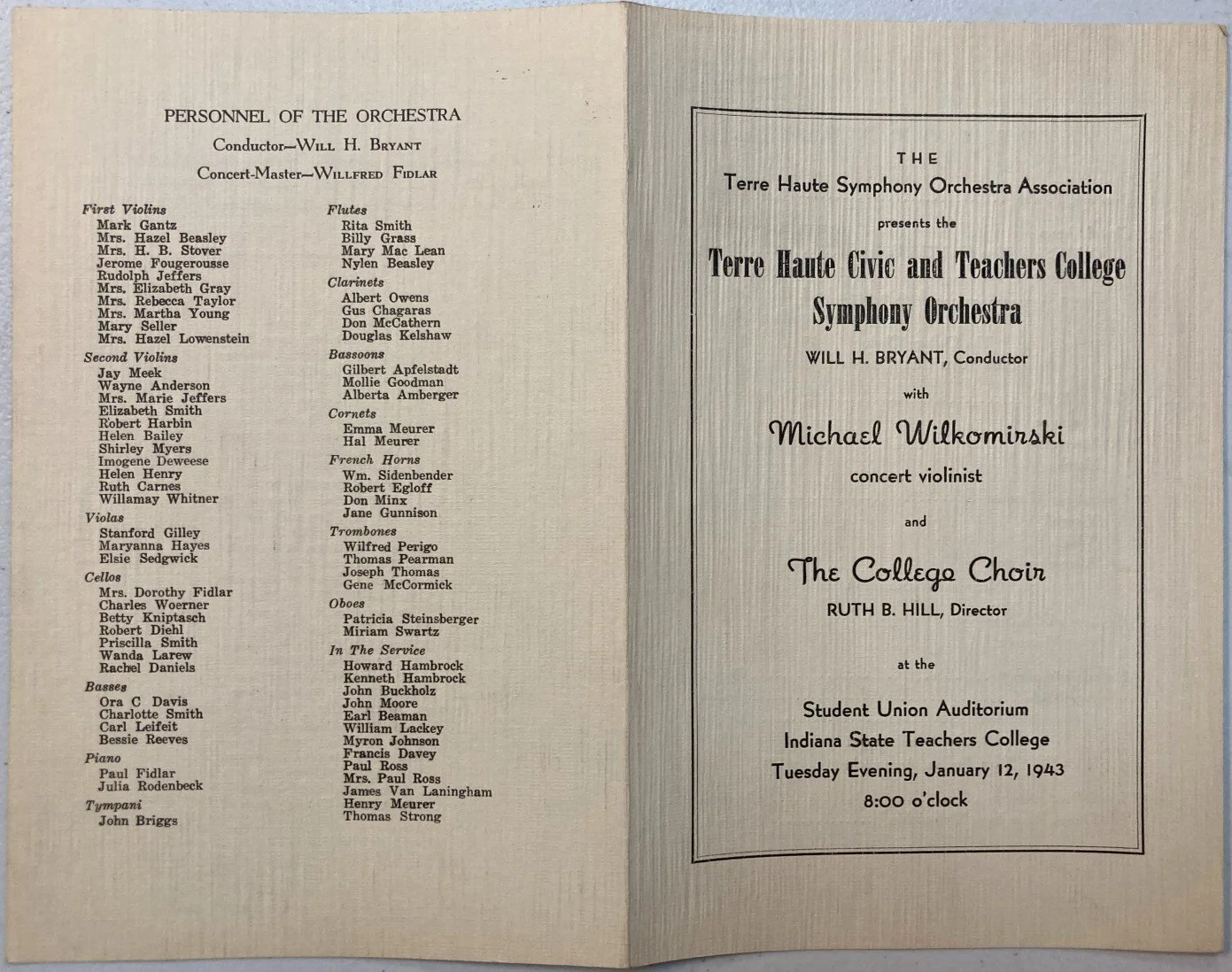
Cover and back of a THCTCSO concert program from January 12, 1943, showing thirteen musicians absent from the orchestra because of their military service; from the THSO internal archive.
But the war did affect the orchestra. When military drafts and enlistments began to shrink the orchestra’s size into the middle years of the war, the THSA board authorized orchestra leaders to recruit from nearby Indianapolis and St. Louis in order to maintain its performing strength. By early 1943, THCTCSO concert programs had begun noting which of its members were absent due to their military service. Many of these were Indiana State students, and almost all of them were residents of the Wabash Valley. And just as the orchestra had always welcomed both men and women into its ranks, it also took care to recognize both men and women for their military service.
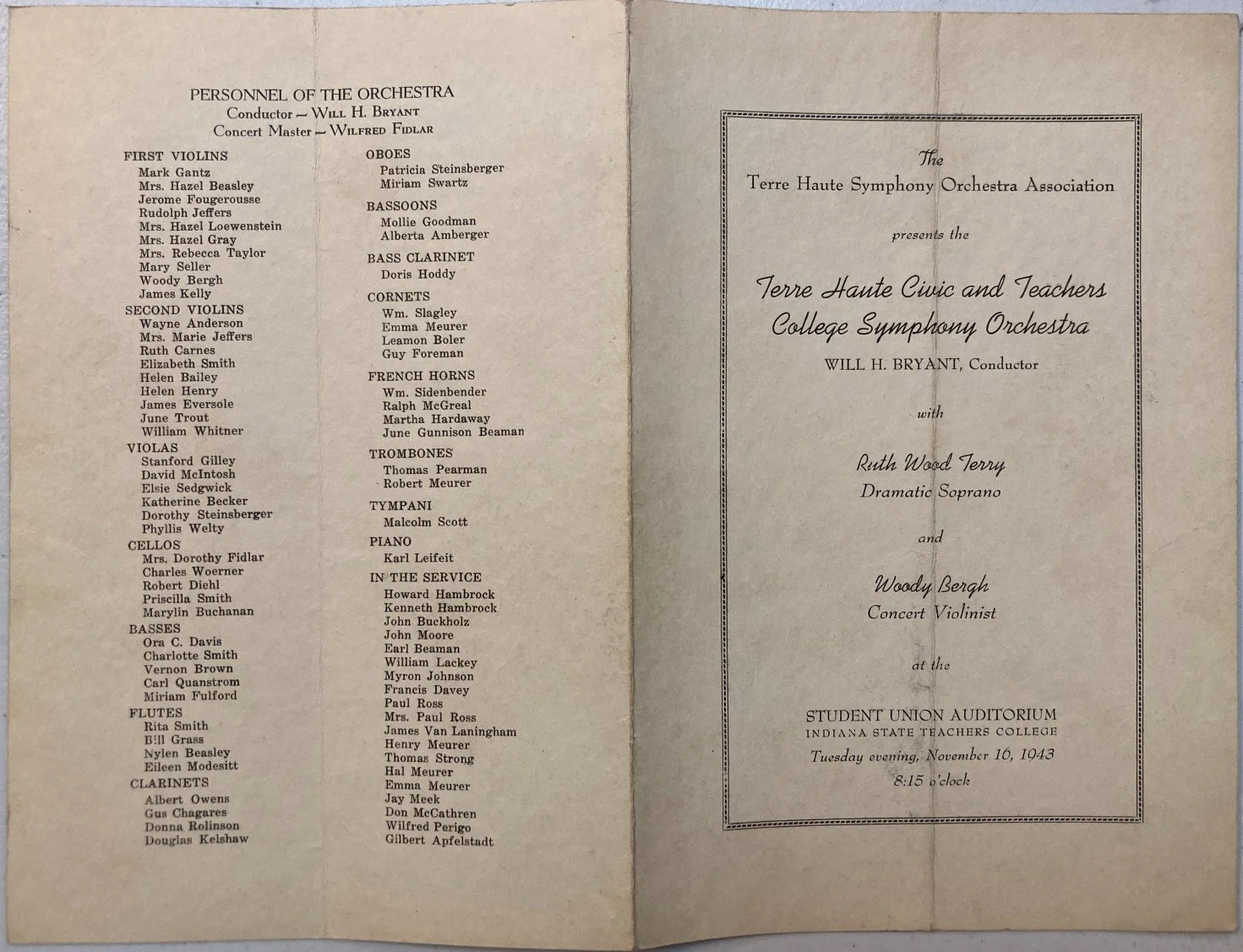
Cover and back of a THCTCSO concert program from November 16, 1943, showing nineteen musicians absent from the orchestra because of their military service; from the THSO internal archive.
A THSO story from the frontlines
“U.S. Soldiers In Africa Find Solace In Hoosier Song On 2-Stringed Violin”
An extraordinary THSO story from the war front was published in the Indianapolis Star on January 3, 1943. Violinist Francis Marasco had grown up in New Goshen and Mecca, Indiana. In 1940 he was drafted into the army and soon earned the rank of Master Sergeant. He eventually found himself stationed in Casablanca, Morocco, repelling the Axis invasion in northern Africa. Here is a selection from an article about Marasco as it appeared in the Star:
It was several weeks after a recent invasion of Africa by American troops that Marasco and some fellow soldiers were looking at the debris that had followed a battle when he found in the ruins a piece of stationery bearing the letterhead of a music store, and another soldier unearthed in the ruins nearby a damaged violin. “Don’t throw that down; that’s a violin,” shouted Marasco. “But it has only two strings,” said the finder. “You can’t play on two strings.” “Maybe I can,” Marasco replied, whereupon he played for the listeners the strains of the Indiana song [“On the Banks of the Wabash,” by Terre Haute composer Paul Dresser].
[…]
Soldiers gathered to listen and Marasco wrote to his parents, “the boys from Maine to California had me play while they sang the favorite songs of their native states. That was the happiest day for everyone since we left the states. We are taking the violin along as a mascot as we advance.”
The sergeant had been known as a patron of music in Terre Haute when he was a student at Rose Polytechnic. He was a member of the Terre Haute Symphony Orchestra […].
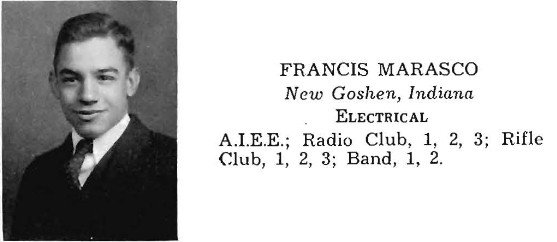
Portrait of Francis A. Marasco, from Rose-Hulman’s 1938 Modulus yearbook.
After the war
With Allied victories in Europe and Japan and the cessation of hostilities in 1945, soldiers, sailors, nurses, and all of the many servicepeople abroad began finding their way back home. While so many families lost loved ones in the conflict, the THSO “family” was lucky to see the return of nearly all of its sons and daughters. The concert program for the THCTCSO’s 20th anniversary concert in March 1946 (already discussed in a previous post) included not only a note recognizing those members still in the service, as before, but they also noted those musicians who were “Returned Veterans” — including the entire clarinet section!
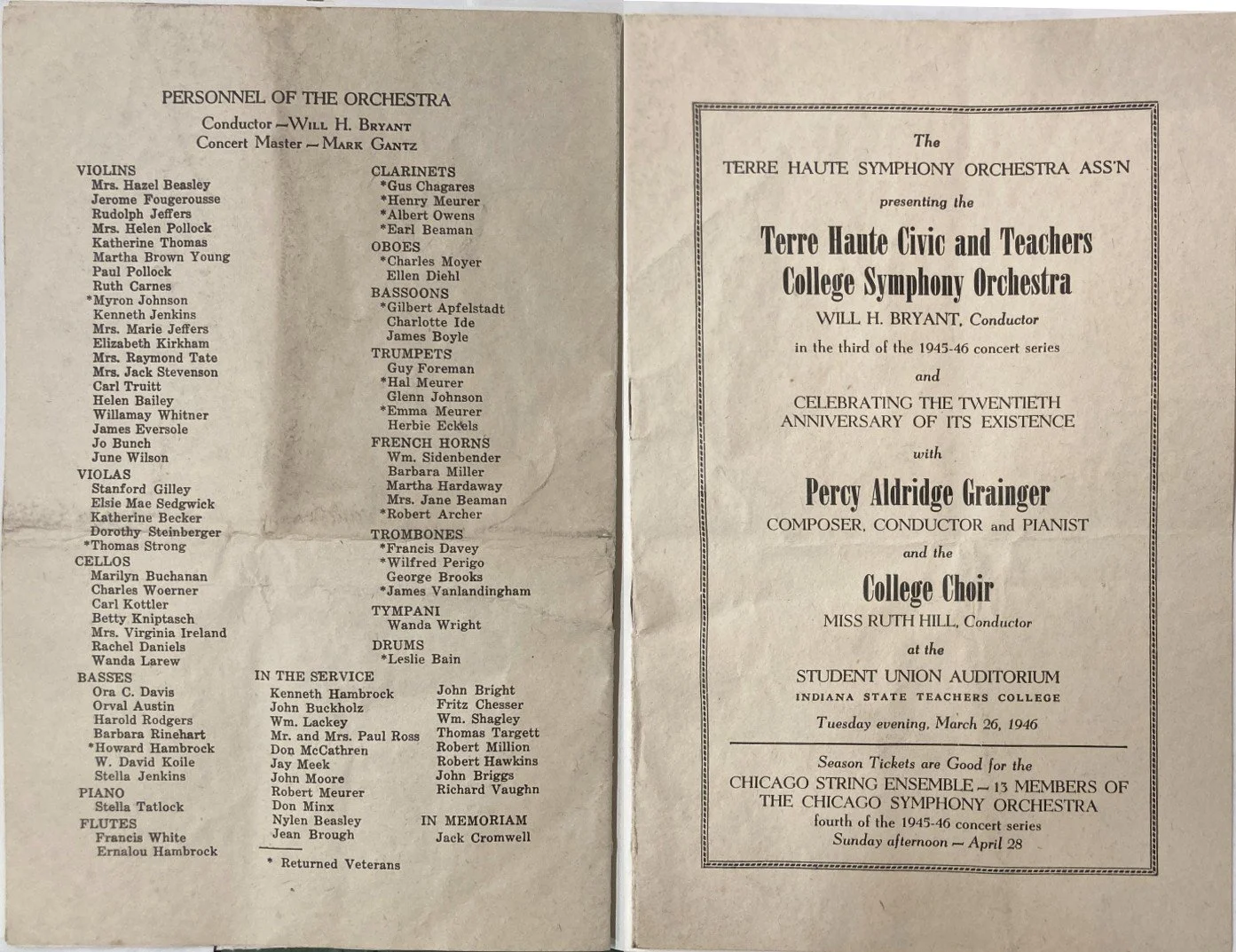
Cover and back of a THCTCSO concert program from March 26, 1946, showing thirty-six veterans and still-active servicemen and -women in the orchestra, including a memorial note for 1st Lt. Jack Cromwell.
Thirty-six active THCTCSO musicians had served in the war, and thirty-five had returned. The anniversary personnel list ends with the note “IN MEMORIUM: Jack Cromwell.” First Lieutenant Jack W. Cromwell’s loss was especially tragic as it had occurred outside of the typical times and places of the war: on August 18, 1945, three days after Japanese surrender had been announced, he was with seven others in a B-17 reconnaissance plane 25 miles south of Manta, Ecuador (South America!), when their plane crashed, killing all eight on board. For too many, the dangers of war didn’t end with the surrenders and liberations of 1945, but continued in the post-war operations and occupations that followed.
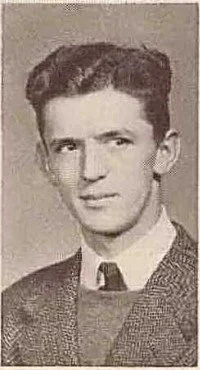
Portrait of Jack Cromwell, from Indiana State’s 1941 Sycamore yearbook.
The veterans named in this post are only those THSO members whose wartime absence was noted during the war years. The United States war effort had called upon more than 16 million men and women — over twelve percent of the total U.S. population at the time. There were undoubtedly dozens if not hundreds more WWII veterans who played in the THSO in the decades after the war, and they may not receive the same level of recognition for their service as the individuals named in this post. Their service was no less worthy than these.
It is hoped that this look at the Terre Haute Symphony Orchestra during the Second World War will honor the service and sacrifice of all who participated in that war, as well as all those who have served and still serve in the United States Armed Forces.
* Widespread knowledge of Nazi campaigns of mass murder and concentration camps came slowly throughout the war and was not fully known or appreciated until hostilities were officially over — too late to save millions of people from the horrors of the Holocaust. The debate over what was known and whether more should have been done earlier continues today.
If you enjoyed this post, consider supporting your hometown symphony with $100 for #THSO100 — a C-note for a Century!
Click here to donate.
Sources:
“Terre Haute Orchestra Affiliated with College,” Indianapolis Star, September 17, 1939, page 17.
“U.S. Soldiers in Africa Find Solace in Hoosier Song on 2-Stringed Violin,” Indianapolis Star, January 3, 1943, page 27.
Indiana State Yearbooks from the following years:
1940: The 1940 Sycamore
1941: The 1941 Sycamore
1942: The Sycamore: Facts and Figures of Forty-Two
1943: 1943 Sycamore
1945: Whispers from the Sycamores: 75 Years at Indiana State
“Nephew of City Man is Killed,” Chronicle Tribune (Marion, Ind.), August 28, 1945, page 2.
“Nephew of Marion Man is Killed in Ecuador,” Leader-Tribune (Marion, Ind.), August 29, 1945, page 5.
Lenora Williamson, “Terre Haute Civic Symphony Plans Twentieth Anniversary Season,” unknown publication, undated (from an archival photocopy of the article).