
The Barnes Era, Part 1 (1949-1961)
David Chapman | June 12, 2026 | history@thso.org
If Will Bryant’s era was about the birth and early survival of the Terre Haute Symphony Orchestra, then Jim Barnes’ era was about expansion, growth, and maturity. Barnes brought the orchestra into its adolescence or early adulthood, as it were, a period in which the orchestra further consolidated and established itself as an elite arts institution in the community.
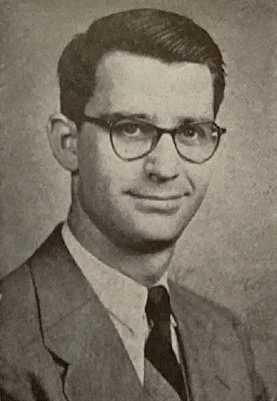
Portrait of James Barnes, second conductor of the TH(CTC)SO, published in a November 15, 1950, concert program.
When Barnes took over directing the THCTCSO, some changes were immediate and obvious. After Barnes’ first concert on November 22, 1949, Lenora Williamson commented in her Terre Haute Tribune review that “Mr. Barnes achieved a newly professional standard for the orchestra in a program of substantial musical merit.” The changes were not just audible, she wrote, but also visible. “Mr. Barnes also banished the pastel appearance of previous seasons as far as the distaff side of the orchestra was concerned. The women were gowned in black velvet and taffeta complimenting the dress suits of the men; this in itself set the first new note, and the program took care of the rest of the transformation.” This transition from “pretty” to “serious” represented in miniature many of the changes to come. It was a first indication that Barnes intended to take the orchestra in new creative directions and to new professional heights. And it reflected a modernist shift taking place in postwar American concert practice, even where the repertoire being played was more crowd-pleasing and traditional. (Though it is beyond the scope of this platform, it is interesting to note the gendered nature of this “pretty vs. serious” framing!)
Another sign of Barnes’ seriousness was his investment in his own growth as conductor and musician. In his first summer break as THCTCSO conductor, he became one of several dozen students who were accepted into Pierre Monteux’s summer school in Hancock, Maine. It was a prestigious and competitive program, with a less-than-10% acceptance rate, but Barnes won it three times in 1950, 1953, and 1954. Monteux was a legendary French conductor who had worked with the famed Ballet Russes in the early century, and it had been Monteux on the podium during the legendary (that is, only partially true) “riot” at the premiere of Stravinsky’s Rite of Spring in 1913. He fled the German invasion of Paris in 1940, became a U.S. citizen in 1942, and soon thereafter established an informal campus in a large manor overlooking Bay Harbor. For those lucky enough to participate, his summer school was a kind of compressed grad school training, with advanced music skills classes in the morning — sight-reading, analytical theory, performance technique — and conducting practice all afternoon. Barnes’ training up to that point had been a good one, but had been focused on the skills necessary to be a secondary schoolteacher. His goal was to elevate himself and thereby all his musical activities, including his new symphony.
Barnes’ pursuit of higher status for himself and his orchestra did not mean abandoning his commitment to the education of young people. This was, after all, his primary concern as a music professor at Indiana State Teachers College. He believed that a sustained effort to reach out to young people would not only grow future audiences for the orchestra, but would also create a farm system for growing future musicians. We examined some of these efforts, including monetary scholarships for young musicians, taking the orchestra into local schools, and a young artists competition, in the prior post to this blog.
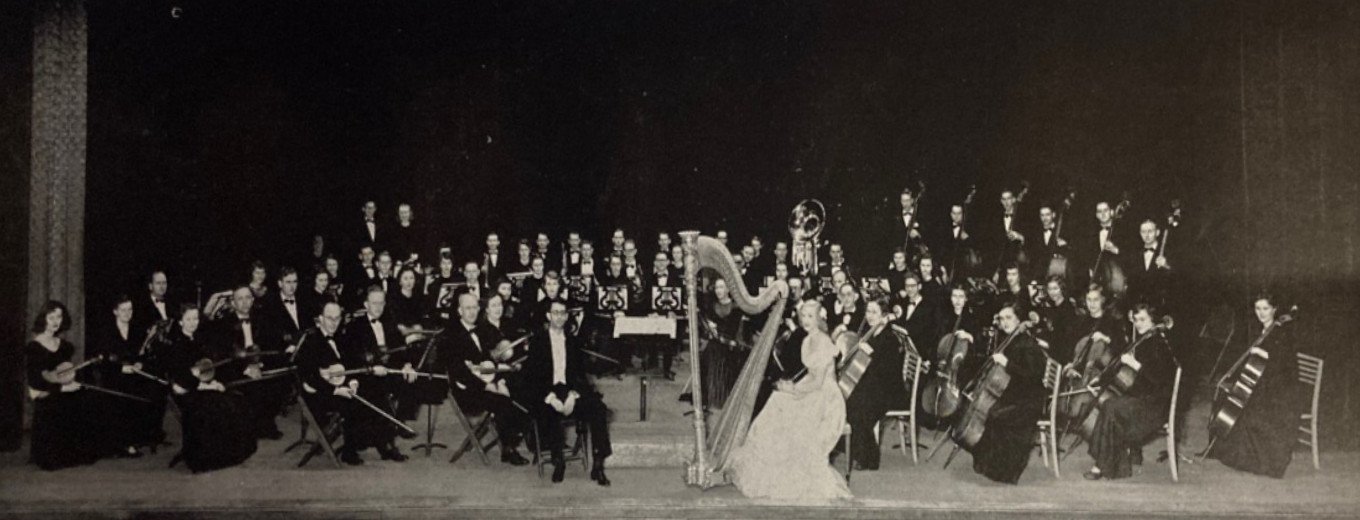
Photo of Lois Bannerman, harp, with the Terre Haute Symphony Orchestra, May 1, 1951, from the first annual Young Artists Contest brochure, internal THSO archives.
Celebrity Guest Artists
But of all Barnes’ efforts, the most visible was the increasing caliber of the guest artists invited to perform with the orchestra. Although he continued featuring prominent local and regional musicians, as had his predecessor, he began to set his sights on some of the biggest names in the orchestral world. Four of these may be taken as representative of that shift.
The first he could hardly take any credit for. Celebrity harpist Lois Bannerman had been scheduled to perform the first concert of the 1949-50 season, and was booked and announced well before it was known that Barnes would be taking over. Bannerman had been a famous child prodigy from Long Island, New York, as well as the subject of a thwarted kidnapping case when she was just 10 years old. She had performed at the Roosevelt White House at the age of 16, which the First Lady later noted in her diary. In the early 1940s, Bannerman attended the Juilliard School in Manhattan and became a major figure in the harp performance world. In the mid-1940s, she appeared in a soundie that has since been preserved on YouTube (embedded above).
Just a few weeks before her planned appearance with the THCTCSO in 1949, however, Bannerman canceled for unspecified reasons and a new guest artist had to be found to replace her. Her IMDB page suggests a potential reason: just a few weeks later, she appeared on Arthur Godfrey’s Talent Scouts on CBS! A further appearance on CBS’s Alan Dale Show followed in 1950. Finally, in May 1951, she made good on her commitment to the THCTCSO, performing Reinhold Gliere’s Harp Concerto with the orchestra. According to newspaper reviews afterward, she was rewarded for her performance with extended applause requiring two encores.
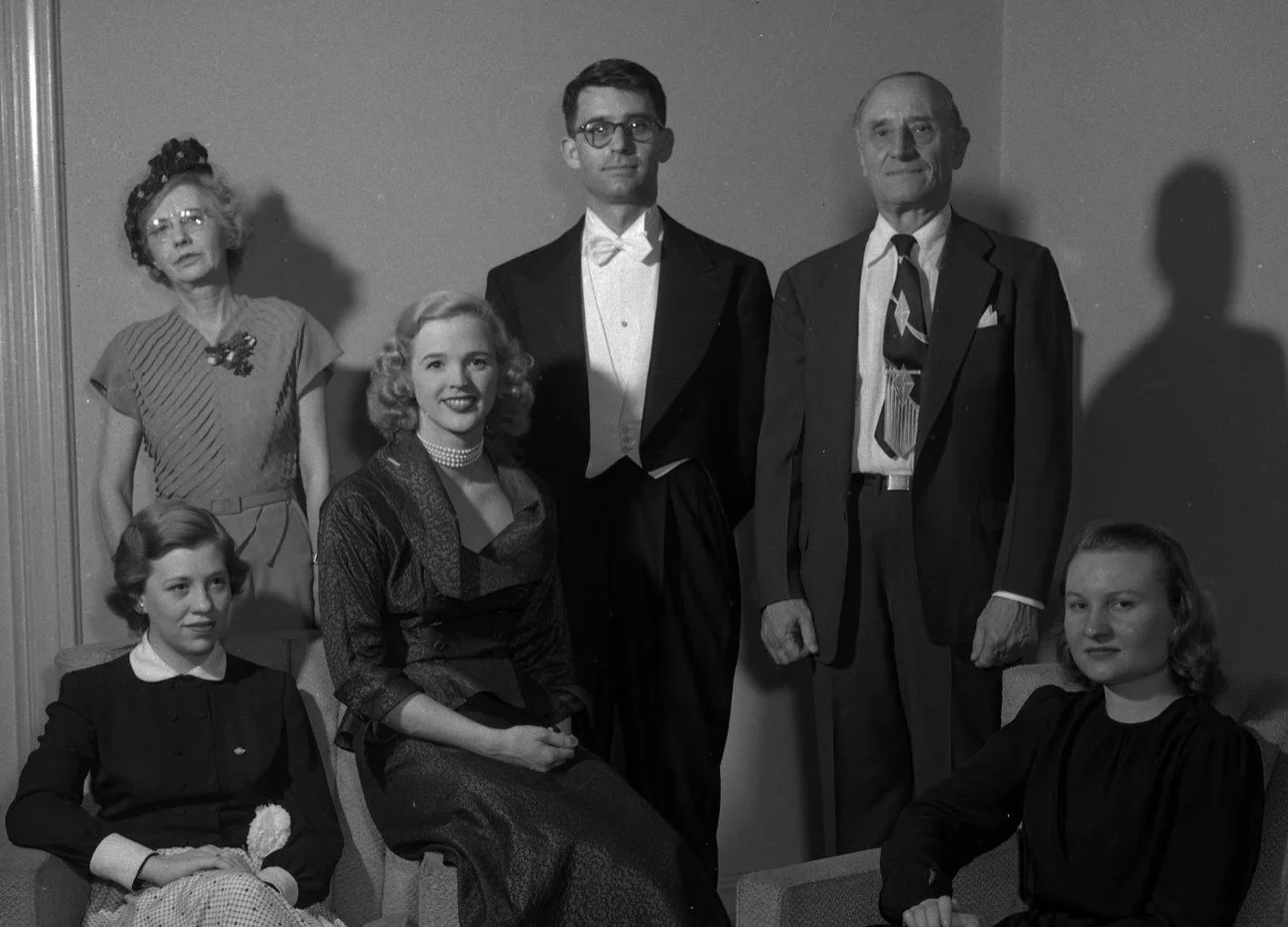
Photo from reception in honor of guest artist Lois Bannerman. Seated left to right: Lou Ann Montgomery, Lois Bannerman, and Bonnie Miller; standing, left to right: Vivien Bard, James Barnes, and Ralph Tirey. Courtesy of Indiana State University Special Collections.
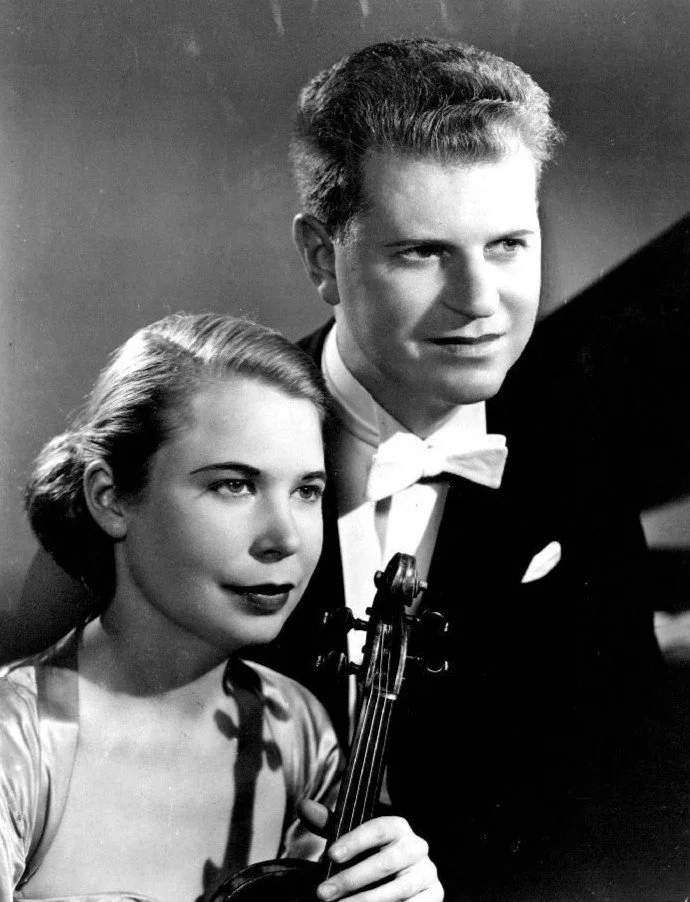
Married musicians Carroll Glenn, violin, and Eugene List, piano, in a 1953 promotional photo by J. Abresch. Public domain, from Wikipedia.
Pianist Eugene List too had launched his career as a child prodigy, appearing with the Philadelphia Orchestra under Leopold Stokowski as a 16-year-old. That performance catapulted him to worldwide fame, because, after planning to play another work, he had been given only six weeks to prepare instead the American premiere of Shostakovich’s First Piano Concerto.
He had also appeared at the historic Potsdam Conference, where Truman, Churchill, and Stalin paused their postwar peace efforts to attend an impromptu concert around a grand piano. When List, then a U.S. Army Staff Sergeant, played the main theme to Tchaikovsky’s First Piano Concerto, Stalin stood and cheered, rushing toward the piano with shots of vodka to share with the pianist. (He was especially pleased to learn that List had premiered the Shostakovich concerto!) Later in the conference, U.S. President Harry Truman — himself an accomplished pianist — sat beside List at the piano and turned pages for him.
After the war, List often appeared with violinist Carroll Glenn, his partner in music and in life! Together, the married musicians became international arts representatives for the U.S. State Department and frequent performers on television. Glenn, too, had been a child prodigy, the youngest student at Juilliard at the age of eleven, giving her concert debut at New York’s famed Town Hall at the age of sixteen. She had performed with orchestras all over the country and had toured the world extensively, performing on her priceless Guarneri “del Gesù” violin from 1742, the “Dragonetti-Walton.”
Terre Haute audiences responded to the 1958 announcement that List would appear with the THSO with considerable excitement. They might have heard the legends about Stalin and Truman at Potsdam, watched one of his many television appearances, or perhaps even seen him star in a small 1946 Hollywood film, The Bachelor’s Daughters. At his THSO concert at the Scottish Rite Temple — formerly the Hippodrome Theatre — on January 27, 1959, List performed Tchaikovsky’s First Piano Concerto in B-flat minor, the same work that had inspired the vodka toast from Stalin. A reviewer afterward described List’s “brilliant technique, his fiery temperament, his appreciation and realization of beautiful and contrasting tonal colors the piano is capable of, made this an excellent and exciting vehicle for his talents.” The author noted that the theatre was full beyond capacity, and that the grateful audience was so thrilled with his performance that they demanded three encores from the pianist before he was allowed to leave the stage.
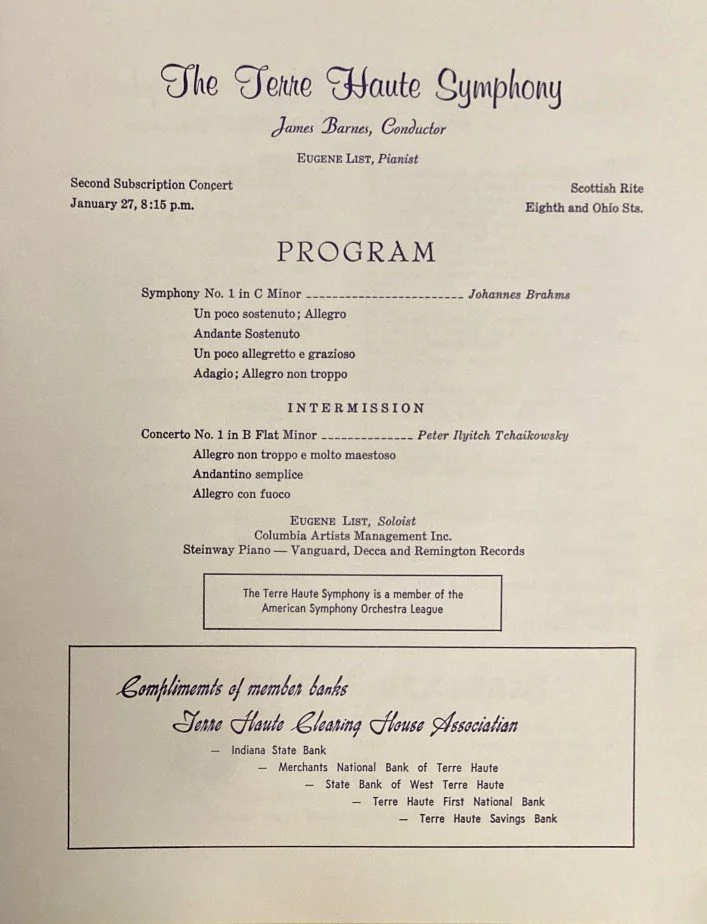
Program from internal THSO archives.
The following season, the THSO featured Glenn as its guest artist. At her May 3, 1960, concert with the THSO, Glenn performed Brahms’ Violin Concerto in D major. Reviewers after the concert described her performance as “a bold and highly individual conception of this work. Her technical mastery of her instrument literally [!] brought down the house, the audience being particularly enthusiastic at the close of the first movement.” Thankfully, the Student Union Building was not literally brought down! But the vivid intensity of the expression suggests a thoroughly raucous applause by the Terre Haute audience.
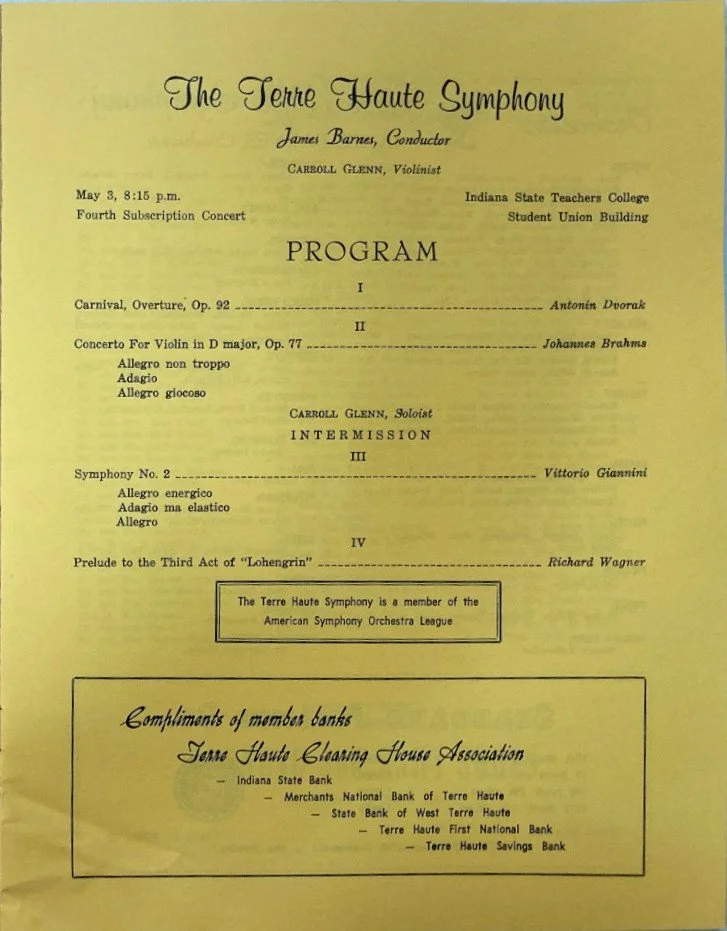
Program from internal THSO archives.
Both List and Glenn would return to Terre Haute to perform with the THSO again in the following decade, with List performing the Poulenc Piano Concerto in November 1966 and Glenn performing the Tchaikovsky Violin Concerto in October 1969.
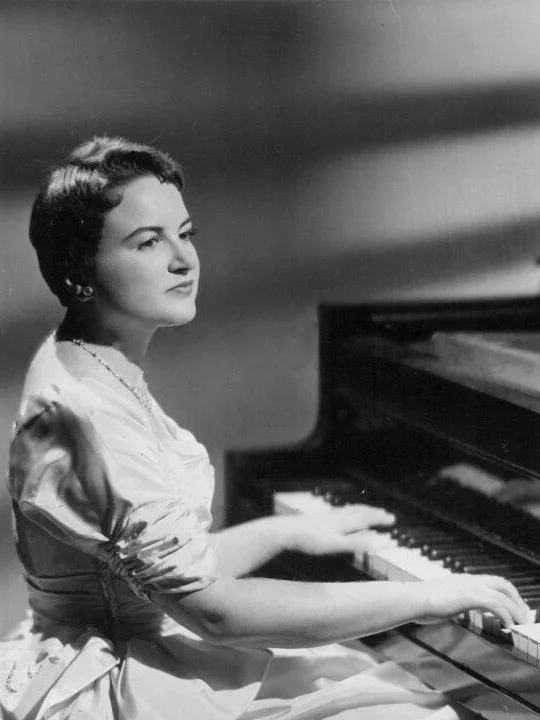
Ruth Slenczynska in a 1957 promotional photo by James Kriegsmann. Public domain, from Wikipedia.
Pianist Ruth Slenczynska, who appeared with the THSO in May 1961, had also been a child prodigy, but had paid a dear price for it. Her fame had included being the last living student of Rachmaninoff, premiering as a concert pianist at 4 years old, debuting in Germany, France, and New York between the ages of 6 and 7, and performing for heads of state in the U.S., Belgium, Romania, and Denmark. She grew up in the spotlight, as it were, and at one point had her life story (short though it then was) told in 18 installments in newspapers all over North America. But all this and much more had happened at the behest of a controlling and abusive father, intent on making her a musical mega-star. By the age of 15, she had already burned out, and in 1940 she withdrew from public musical life and emancipated herself from her father. She spent the next twelve years putting herself through college, getting married, and rediscovering music in private and on her own terms. Her triumphant return to the big stage took place in 1956 when she performed Chopin’s Second Piano Concerto at Carnegie Hall with the New York Philharmonic. Her brilliant international career re-commenced thereafter.
When newspapers announced that Slenczysnka had been booked to play with the THSO, many in the local audience knew her from her May 1960 appearance on Ralph Edward’s NBC show This Is Your Life. Others might have heard her perform a solo recital at St.-Mary-of-the-Woods that same year. However they learned of her, a capacity crowd turned out to hear her perform with our hometown orchestra in spring of 1961.
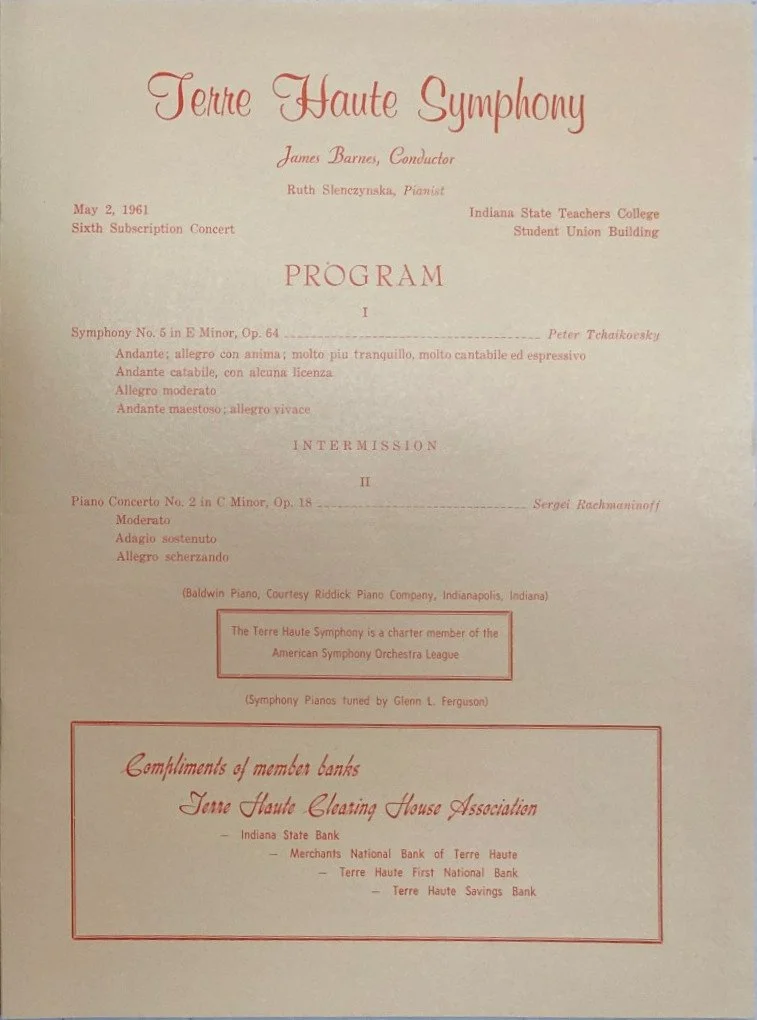
Program from internal THSO archives.
She took the stage with the Terre Haute Symphony on May 2 and performed the Second Piano Concerto of her former teacher Rachmaninoff. Frederick Black, writing afterward in the Terre Haute Star, noted that “Miss Slenczynska showed herself the possessor of a first rate technic […] Short in stature, still looking rather like the chubby girl who made so big a hit, she played with a surprisingly big tone, with color and fire.” (Although not surprising, one still regrets to read comments about a young woman’s body weight in so public a forum. Alas…)
Benjamin Benjaminov, Rose Polytechnic professor (and future THSO board president), wrote in the Terre Haute Tribune that Slenczynska had “displayed not only her remarkable technical command of the instrument but also, and above all, her warmth, sensitivity and vigor. […] She seemed to surpass herself by treating difficult passages with passion and strength — and yet with moving tenderness and full cognizance of their tonal beauty.”
Side note: After an extraordinary life of 101 years, Ruth Slenczysnka passed away on April 22, 2026, only 50 days ago!
Intermezzo
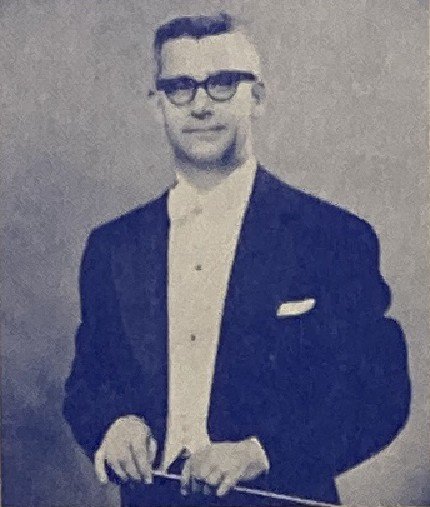
Portrait of James Barnes published in a 1961-62 THSO season brochure. From internal THSO archives.
The year 1961 was just past the midpoint of the Barnes Era, though only we future-dwellers know this. Enthusiasm for the symphony and its direction was at an all-time high. On May 10, 1961, the week after Slenczynska’s appearance with the THSO, Margaret Beecher wrote the following observations in the Terre Haute Star:
When Dr. James Barnes was handed the baton to lead the Terre Haute Symphony twelve years ago many people were surprised. For some time the Terre Haute Symphony had been faltering. How could a man of Barnes’ youth cope with the task of building up an organization worthy of the public’s plaudits? It’s a happy fact that during the past twelve years since Jim Barnes stepped up on the podium and plunged into his first public conducting of the group, the Symphony has matured right along with him. This is no coincidence. Jim Barnes enjoys that one great virtue — optimism, which in turn engenders itself into tenacity of purpose, a knack of sensing what the public not only likes but what they need, and an unqualified self-discipline so necessary to inspire his performers.
Four days later, in the Tribune-Star Sunday edition, she continued:
After looking into how our local musical offerings size up to those being offered in other Indiana cities, and one in Kentucky, it would appear we are in pretty good shape. In fact, we’re in real good shape. If you consider the strides the Terre Haute Symphony alone has made these past few years, with Jim Barnes at the helm (and he is the one who deserves most of the credit) Terre Haute can point to its symphony with pride.
Beecher’s enthusiastic accounting was an argument on its way to an important point: “Good music costs money. The bigger and better the talent, the more it costs. […] Symphony business is not play. It’s a significant business in helping to make our community a place in which to stay happy.” As the symphony grew and matured, so too did its costs rise. A final sign of the maturity toward which Barnes strove was the choice to pay every musician in the orchestra starting in the 1962-63 season. And that meant that the orchestra, its governing association, and the community that supported them, would need to reckon with those expanding needs with higher levels and broader methods of support.
To be continued…
Over the next several weeks, we will finish this story by looking at the merger of the THSO with Terre Haute’s Civic Music Association, the prestigious guest artists of the 1960s (sneak peak: Isaac Stern, Sigurd Rascher, William Warfield, Robert Shaw, Dave Brubeck, and more!), and the founding of the Women’s Symphony Society as an effort to address fundraising needs that necessarily accompanied the orchestra’s period of extraordinary growth.

It is still true what Margaret Beecher wrote in 1961:
”Good Music Costs Money.”
If you enjoyed this post, consider supporting your hometown symphony with $100 for #THSO100 — a C-note for a Century!
Click here to donate.
Sources on James Barnes and the THSO:
Lenora Williamson, “Large Crowd Enjoys Program by T.H. Civic and College Orchestra,” Terre Haute Tribune, November 23, 1949, page 14.
“Music Instructor Will Take Special Course,” Evansville Press, July 30, 1950, page 10.
“Conductor Studies with Monteaux in Preparation for New Season,” Terre Haute Tribune, page 25.
Margaret M. Beecher, “Symphony Gains Under Leadership of James Barnes,” Terre Haute Star, May 10, 1961, page 3.
Margaret M. Beecher, “Terre Haute Symphony Making Contributions to Community,” Terre Haute Tribune-Star, May 14, 1961, page 27.
Sources on Lois Bannerman and the THSO:
Lenora Williamson, “Prof. Bryant, Symphony Conductor, Leaving to Accept New Position, Terre Haute Tribune, August 18, 1949, pages 1 and 9.
“Symphoy Rehearses in Preparation for Season with New Conductor,” Terre Haute Tribune, October 2, 1949, page 25.
“One More Concert by Local Symphony,” Terre Haute Tribune, April 18, 1951, page 8.
“Harpist Appears in Concert May 1,” Terre Haute Star, April 19, 1951, page 2.
“Lois Bannerman, Harpist Soloist for Last Symphony Orchestra Concert,” Terre Haute Tribune, April 22, 1951, page 26.
“Lois Bannerman, Harpist, Will Appear with Civic Orchestra,” Terre Haute Tribune, April 29, 1951, page 30.
“Symphony and Harpist Please Audience,” Terre Haute Tribune, May 2, 1951, page 11.
Sources on Eugene List and Carroll Glenn with the THSO:
“Pianist Eugene List Symphony Artist on Jan. 27,” Terre Haute Saturday Spectator, January 24, 1959, page 10.
“Symphony Concert and Pianist List Well Received,” unknown publication, January 28, 1959, n.p.
“Violinist Carroll Glenn Symphony Guest Artist,” Terre Haute Saturday Spectator, April 23, 1960, page 7.
“Symphony Offers Carroll Glenn in Concert Tuesday,” Terre Haute Star, April 28, 1960, page 4.
“Carroll Glenn to be Presented by Symphony,” Terre Haute Tribune, April 29, 1960, page 12.
“Reception for Noted Violinist to Follow Concert,” Terre Haute Tribune-Star, May 1, 1960, page 42.
“Reception Tonight for Guest Artist,” Terre Haute Star, May 3, 1960, page 6.
“Reception Tonight After Concert,” Terre Haute Tribune, May 3, 1960, page 8.
“Local Symphony Ends Season with Brilliant Concert,” Terre Haute Tribune, May 4, 1960, page 8.
“Terre Haute Symphony to Present Eugene List,” Terre Haute Tribune, October 23, 1966, page 42.
“Symphony Season Opens, Eugene List Guest Soloist,” Terre Haute Saturday Spectator, October 29, 1966, page 6.
“Tickets On Sale for List Concert,” Terre Haute Tribune, November 1, 1966, page 14.
“Eugene List Well Received with Concertos,” Terre Haute Tribune, November 2, 1955, page 17.
“Second Concert Scheduled Oct. 28 by Symphony,” Terre Haute Tribune-Star, October 26, 1969, page 41.
“Symphony Presents Second Concert of New Season,” Terre Haute Tribune, October 29, 1969, page 22.
Sources on Ruth Slenczynska and the THSO:
“Ruth Slenczyska [sic] to Appear with Terre Haute Symphony,” Terre Haute Tribune-Star, April 23, 1961, page 37.
“Concert to Open Terre Haute Drive,” Indianapolis Star, April 27, 1961, page 26,
“Pianist of Note Ruth Slenczynska Symphony Soloist,” Terre Haute Star, May 1, 1961, page 6.
“Ruth Slenczynska Symphony Soloist Tuesday Night,” Terre Haute Tribune, May 1, 1961.
“Dinner Launches Symphony Season Ticket Campaign,” Terre Haute Star, May 2, 1961, page 2.
“Local Symphony Ticket Campaign Opens for Season,” Terre Haute Tribune, May 2, 1961, page 6.
Frederick Black, “Closing Symphony Concert Attracts Capacity Audience,” Terre Haute Star, May 3, 1961, page 3.
Benjamin S. Benjaminov, “Brilliant Concert Closes Current Symphony Season,” Terre Haute Tribune, May 3, 1961, page 9.
“St. Mary’s Honors Concert Pianist,” Terre Haute Tribune-Star, May 7, 1961, page 25.