
The THSA/WVCMA Merger (1961)
David Chapman | June 19, 2026 | history@thso.org
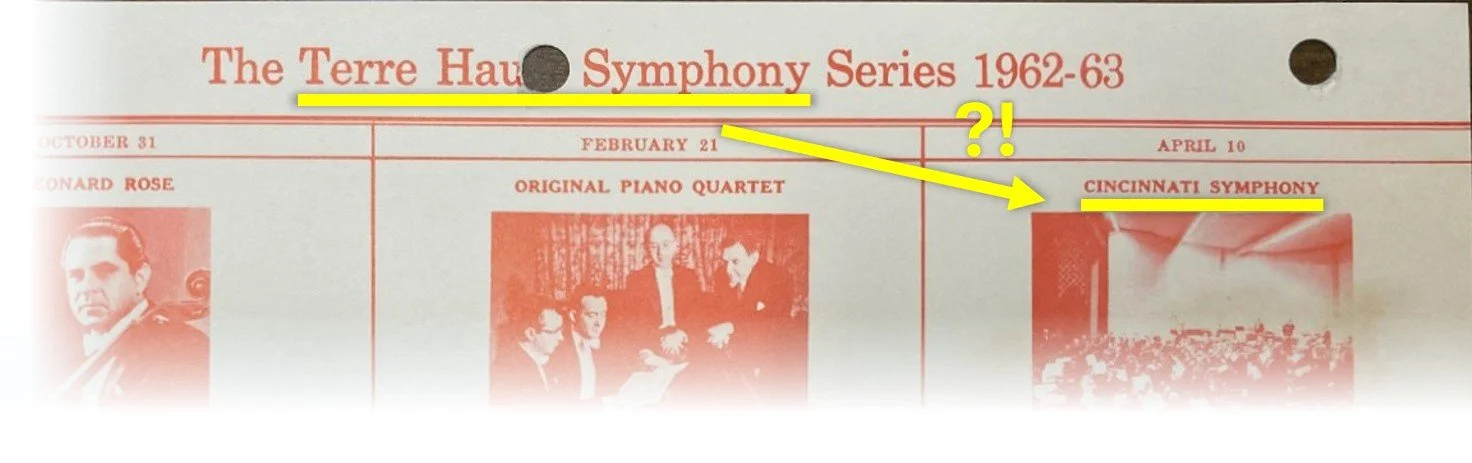
The Terre Haute Symphony Orchestra 1962-1963 Season Brochure, indicating that the Cincinnati Symphony Orchestra would appear as part of the THSO season. From the THSO archives at Vigo County Public Library.
In March 1961, local newspapers announced that the Terre Haute Symphony Association and the Wabash Valley Civic Music Association had merged. It was a noteworthy consolidation of two major institutions in the region’s classical music community. It meant that the THSA, which to that point had only overseen the THSO, would now also host several non-THSO performing arts events, including ballets, operas, and solo recitals… even other symphony orchestras! Today’s post explores Civic Music Associations: what they were, how our city came to have one, and how it became part of the THSA.
The “Organized Audience Plan”
In the 1920s, a remarkable new idea took hold in the American classical music scene. Variety magazine would eventually call it “perhaps the most revolutionary idea ever introduced in the realm of concert-giving in this country.” Its official name was the Organized Audience Plan and its aim was to bring major fine-arts performers into small- to medium-sized towns with minimal cost and burden to those communities: “a Carnegie Hall in every town,” as one agency put it. Citizens would form local organizations affiliated with national booking agencies such as the United Audience Service or Community Concerts, Inc. These local affiliates would hold a week-long fundraising drive each year in which individuals could buy membership at a reasonable cost, typically $5 (roughly $100 today) or $2.50 for students. In return, they would receive one year of access to concerts in their own hometown featuring visiting artists with national profiles. Additional subscriber perks included requesting the specific acts they would like to see as part of the series and being able to attend similarly arranged civic music events in nearby towns.
It was equal parts strategy and zeal, a business plan crossed with a cultural movement. The pitch to communities was the promise of high-quality performers and the benefit of positive balance sheets: they would no longer need to speculatively book major artists and then hope to sell enough tickets or entice sufficient sponsorship. All the money for a season was raised in advance and thus both artists and hosts were guaranteed to cover their costs and fees. The benefit to the national organizations, of course, was better access to smaller markets and more bookings for performers.
Hundreds of non-metropolitan communities across the United States organized their own civic music associations (CMAs) to participate in the new Organized Audience Plan. Even during the Great Depression, many traveling operas, ballets, and orchestras endured and local arts appreciation grew thanks to the plan’s reasonable costs for audience members and financial assurances for artists and institutions. Then, in the aftermath of Depression and World War, these organizations were especially well positioned to ride the new wave of cultural enthusiasm in the postwar period.
It was not without its critics: artists especially complained about being forced to discount their regular fees and about the comparatively narrow aesthetic tastes of small-town audiences. But the Organized Audience Plan was a remarkably successful model for bringing high-caliber concerts into every part of the country and for helping live performing arts compete with “talking pictures.” The plan was even exported outside of the U.S. to Canada, Mexico, and abroad.
The Terre Haute (later, Wabash Valley) Civic Music Association
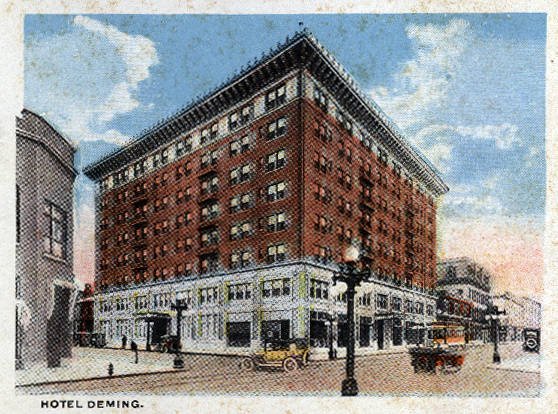
Vigo County Community Collection, Vigo County Public Library.
Sometime in 1928, Elvada Tessman Thompson (a.k.a., “Mrs. Colonel Thompson of South Twentieth Street”) called a meeting in her home to form Terre Haute’s own Civic Music Association, which would be affiliated with Civic Concert Service, Inc., out of Chicago. Officers and captains were elected — including several THSO associates — and a recruitment effort began. Its first membership drive took place in mid-February 1929. Campaign headquarters were established in the Hoosier Nook ballroom of the Hotel Deming (the same building in which the THSO has its offices today!). Twenty teams of five canvassers fanned out across Terre Haute seeking subscribers, with a mandate to secure at least 600 or the entire endeavor would fail before it even began. By the end of the week, almost 1,500 subscriptions had been sold.
“Civic Music Association Meeting with Great Success in Movement to Secure High Class Attractions”
The first concert of the Terre Haute CMA took place on March 20, 1929, at the Shriner’s Temple on 7th Street. The concert featured the mighty Cleveland Orchestra, then only ten years old, but which was already making a major name for itself in live concerts and on phonograph recordings. Preview articles announced the program with excitement — Brahms’ Third Symphony, Lalo’s Symphonie Espagnole, Sibelius’ Swan of Tuonela, Wagner’s Lohengrin Act III Prelude — but they also invariably ended with a wagging of the proverbial finger: “Citizens who were not foresighted enough to buy season tickets will not be admitted, since admission will be on the presentation of membership tickets only.” Although the week-long sales campaign had been open to anyone willing to pay, this tone of subscriber-only exclusivity would become another substantial point of criticism against the Organized Audience Plan in the long run.
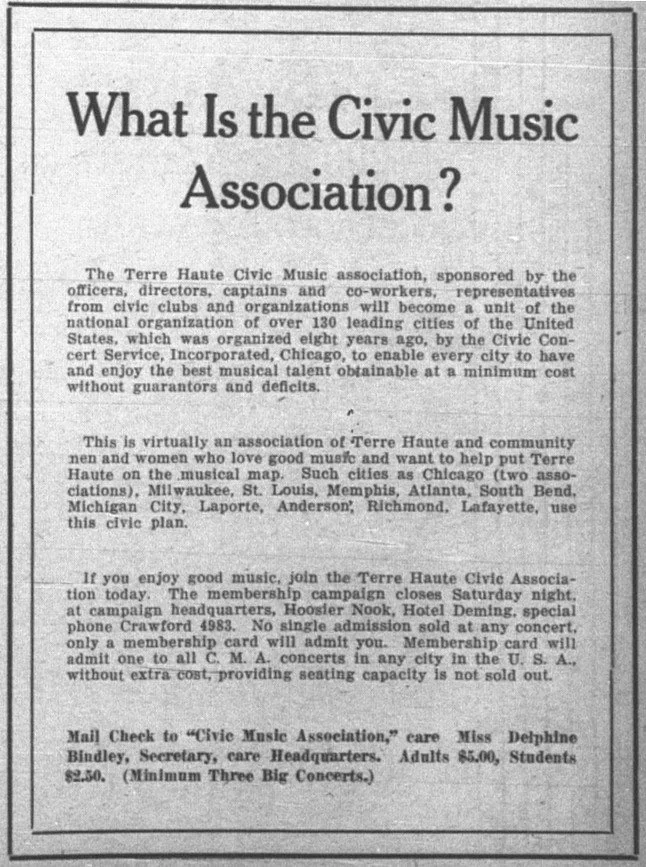
From the Terre Haute Saturday Spectator, February 16, 1929, page 9.
Over the following three decades, the local CMA expanded its nominal geography from Terre Haute to the Wabash Valley and provided an extraordinary range of artists and ensembles to the community. As with all such activities in Terre Haute, WVCMA personnel overlapped significantly with all other arts organizations in town, including the THSO. Every season saw a mix of solo musicians, dance and opera companies, chamber music groups, and large orchestras. These included the following (and many more):
Solo performers
Eleanor Steber, soprano at New York’s Met Opera (February 1948)
Ruggiero Ricci, violinist famous for his performances of the Paganini Caprices (November 1949)
Martial Singher, baritone at New York’s Met Opera (February 1950)
Ellabelle Davis, soprano, and Lawrence Winters, baritone, ground-breaking African American opera stars, crossing classical music’s version of the color barrier (January 1951)
Isaac Stern, international mega-star violinist and cultural diplomat (January 1953)
Marina Svetlova, New York ballet star and future professor and department chair of the Indiana University dance department (April 1954)
Blanche Thebom, soprano (February 1959)
Small ensembles
Vienna Boys’ Choir (November 1948 and January 1958)
Robert Shaw Chorale (October 1949)
Boris Goldovsky’s Opera Theater Company (November 1953)
Charrat Ballet Company (October 1957)
Juilliard String Quartet (March 1958)
Major symphony orchestras
Indianapolis (January 1948 and March 1952)
Minneapolis (February 1949 and February 1954)
Cincinnati (October 1950 and March 1956)
Cleveland (returning November 1952)
Detroit (March 1955 and January 1957)
National Symphony from Washington, D.C. (March 1959)
Records are rather difficult to access between 1929 and 1948, so this list is not comprehensive, but merely representative and focused only on the post-1948 era. Future scholars especially take note: this is an area ripe for exploration!
Fast-Forward to the Merger
On May 27, 1959, the board of the Wabash Valley Civic Music Association met as usual in the Green Room of the Terre Haute House at 7th and Main. The Terre Haute Tribune reported on June 9 that Robert H. Dewey was re-elected president and would continue to serve alongside eight other officers, twenty-one existing board members, and three new ones, including some who were starting fresh three-year terms. THSO Conductor Jim Barnes remained head of the programming committee, a role he had already performed for several years. Grace Ruth, field representative for the Civic Concert Service came to town from New York to discuss plans for the membership campaign, which was scheduled to open on September 14. By this time in the late 1950s, the week-long campaign had been moved from early spring to early fall and the events calendar now followed the more typical concert season (roughly the same as an academic calendar, September through May). Based on the successes of the prior year, which had ended with a barn-storming concert and two encores by the National Symphony Orchestra, hopes must have been high for the new season. If trouble was brewing internally, it was not reported in the local papers.
“Concert Series is Abandoned”
On September 17, 1959, the Tribune announced that the WVCMA had canceled its 1959-1960 season and would not hold its annual membership campaign after all. The reasons for this abrupt end remain unclear, though there is some evidence that community interest may have weakened during this time, perhaps stretched too thin by competition from other organizations also bringing in major artists, including the THSO and the colleges. Sporadic WVCMA board meetings continued, and a delegation of the board attended the annual national convention of CMAs in Chicago the following January. But no concerts were held under the auspices of the Wabash Valley Civic Music Association ever again.
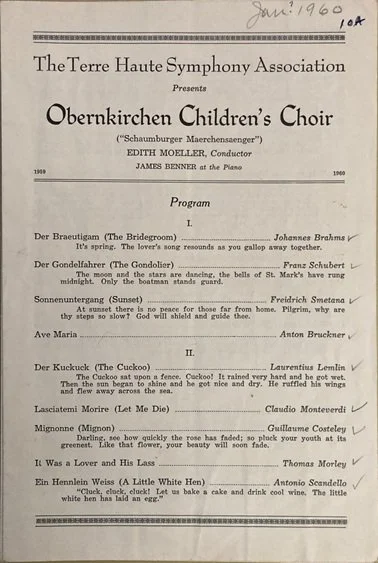
Program from THSO archives at the Vigo County Public Library.
In the fallow period for the WVCMA that followed, the THSA attempted to take up some of the slack. The THSA’s five-concert season in 1959-1960 included the four regular concerts by the THSO and what seems to have been a hastily arranged event featuring the Obernkirchen Children’s Choir in November 1959. The event did not appear on any of the THSO’s pre-season announcements the previous summer, and the first notice to the public came only two weeks before the concert. The Terre Haute Tribune reported shortly before the children’s choir concert that WVCMA president Robert Dewey “has commended the association for taking the lead in bringing top artists and choral groups to the city.” It seems plausible that the choir had been part of the WVCMA’s planned season, but the THSA stepped in to host them at the last minute when the organization shut down. As Dewey’s comments seem to indicate, it would be up to the THSA to do the work of the CMA moving forward.
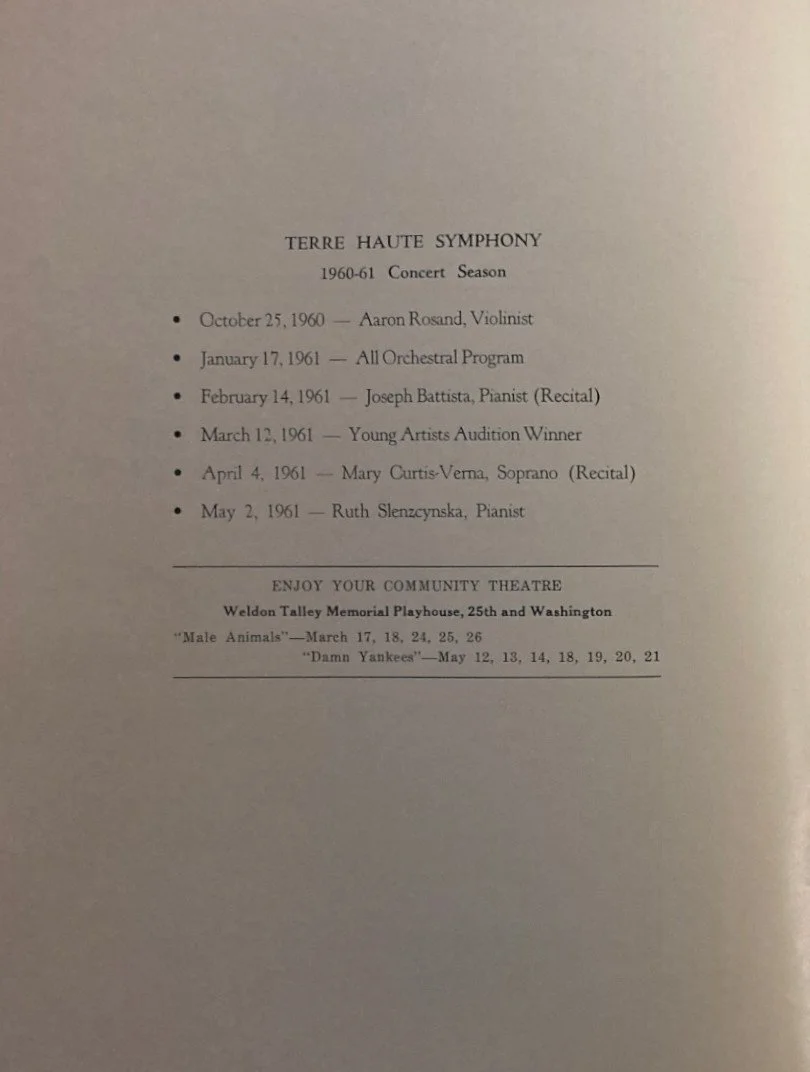
From internal THSO archives. *I note with particular pleasure the comment in support of the THSO’s twin-sister organization, the Community Theatre of Terre Haute, who is also celebrating its 100th anniversary in 2026. With any luck we should hear about the history of the CTTH on this very blog in the near future!
The THSA season expanded again to six concerts in 1960-1961 with the inclusion of two solo recitals by pianist Joseph Battista and by soprano Mary Curtis-Verna. These were announced alongside the full THSO concerts in regular pre-season promotions, and listed in programs throughout the year. (Note that this is the season that ended with Ruth Slenczynska’s performance with the THSO, described in some detail in the previous post to this blog.)
On February 1, 1961, midway through the season, the WVCMA Board attended a joint meeting with the Terre Haute Symphony Association Board. A merger of the two organizations was proposed and approved by the THSA. The move would combine the two organizations’ accounts, the THSA’s board would expand from 21 to 39 members, and the THSA would officially embrace its new mission to include hosting major non-THSO events. The CMA’s subscription-only ticket model and its national affiliation would end and the newly combined organization would continue on the THSO’s model: a full-season schedule would be announced ahead of time alongside sales of season tickets and individual concert tickets would be offered at the door. It meant more flexibility and access for audiences, but it also meant the end of the financial guarantees and easy talent pipeline of the CMA model. The merger was finalized and announced on March 10, 1961.
“Civic Music Votes to Join Symphony”
The merger aligned well with the THSO’s new emphasis on high-caliber guest artists in Jim Barnes’ era as conductor. But it also meant that the THSA now oversaw more than just the THSO. For audiences at the time, the changes mostly meant more time and means to secure tickets to big events. For us looking back, they explain why THSO season tickets in the early Sixties began including some concerts without the THSO in them! These events were the enduring legacy of the Wabash Valley Civic Music Association, whose mission was taken up by the THSA after 1961.
And the fundraising needs of the THSA grew accordingly, even exponentially.
Next week, we will examine the founding of the Women’s Symphony Society in 1964 as a remedy for those expansive new fundraising needs.
Speaking of which…
…if you enjoyed this post, consider supporting your hometown symphony with $100 for #THSO100 —
a C-note for a Century!
Click here to donate.
Sources on the founding and first concert of the Terre Haute / Wabash Valley Civic Music Association:
“Civic Music Association,” Terre Haute Saturday Spectator, February 9, 1929, page 30.
“Civic Music Association Meeting With Great Success in Movement to Secure High Class Attractions,” Terre Haute Saturday Spectator, February 16, 1929, pages 5 and 9.
“Cleveland Symphony Orchestra,” Terre Haute Saturday Spectator, March 9, 1929, page 9.
“Cleveland Symphony Orchestra,” Terre Haute Saturday Spectator, March 16, 1929, page 28.
“Civic Music Association,” Terre Haute Saturday Spectator, May 4, 1929, page 16.
“Civic Music Celebrates Silver Anniversary Membership Week,” Terre Haute Tribune, September 13, 1953, page 44.
“Civic Music Plan is Explained,” Terre Haute Tribune, September 13, 1953, page 44.
“Civic Music Brings Minneapolis Symphony for Winter Concert,” Terre Haute Tribune, September 13, 1953, page 45.
Sources on the WVCMA’s canceled season, 1959-1960, and merger with THSA in early 1961:
“Civic Music Board, Officers to Meet,” Terre Haute Tribune, May 27, 1959, page 8.
“Officers Elected by Civic Music Group at Meeting,” Terre Haute Tribune, June 9, 1959, page 6.
“Concert Series is Abandoned,” Terre Haute Tribune, September 17, 1959, page 2.
“Presentation of Children’s Choir Receives Support,” Terre Haute Tribune, November 16, 1959, page 7.
“Convention Guests,” Terre Haute Tribune, January 10, 1960, page 40.
“2 Music Groups in Merger Move,” Terre Haute Star, February 2, 1961, page 2.
“Symphony Board Votes Merger with Civic Music,” Terre Haute Tribune, February 2, 1961, page 5.
Dr. Wayne Crockett, “Modern Music Lovers Lack Old Spontaneous Reaction,” Terre Haute Tribune-Star, February 5, 1961, page 20.
“Civic Music Vote to Join Symphony,” Terre Haute Tribune, March 10, 1961, page 15.
“Merger of Music Groups Approved,” Terre Haute Star, March 11, 1961, page 3.