
The Women’s Symphony Society of Terre Haute (1964-1978)
David Chapman | June 26, 2026 | history@thso.org
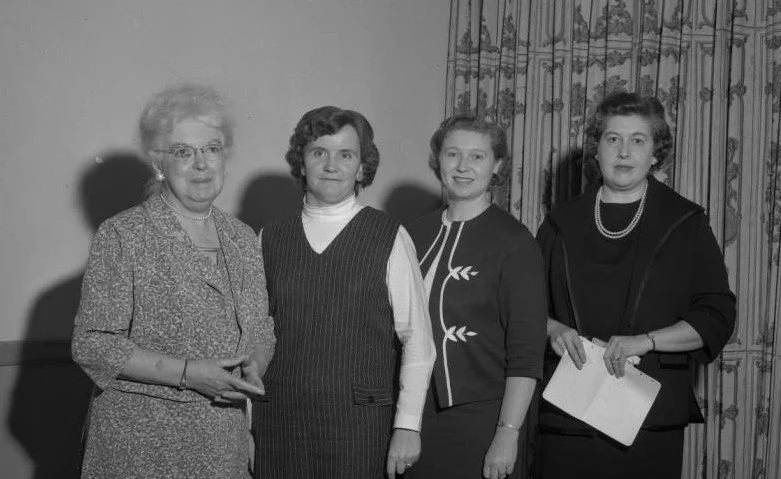
Photo of officers for the new Women’s Symphony Society of Terre Haute, taken September 24, 1964. Woman on the far left is Mary (“Mrs. Raleigh”) Holmstedt, “First Lady” of Indiana State College (1953-1965), and first president of the Symphony Society (1964-1965). The rest of the women are unidentified at this time. Let us know if you can help us identify them! See the * footnote below: their names are likely in that list. Courtesy of Indiana State University Special Collections.
Our previous post on the early Jim Barnes era ended with Margaret Beecher’s happy but frank assessment of the Terre Haute Symphony Orchestra’s health in May 1961. Overall, she observed that the THSO lacked nothing in quality or energy, and she noted especially the excellent leadership of conductor James Barnes. However, she insisted, an orchestra doing its best work is also an organization with great needs.
The support infrastructure surrounding the THSO had not kept pace with its overall growth, Beecher argued, and this was clearest when comparing the orchestra to its peers in other towns:
Our sister city, Muncie, comes the nearest to resembling us in terms of population, the size of its symphony, its organization and support. Muncie also has the advantage with a college music department. Where Muncie is in its twelfth season, we are in our thirty-fifth – the Terre Haute Symphony being the state’s oldest. Muncie’s symphony functions on a budget of $9,999; our current budget is $8,100. One advantage Muncie has we don’t is a Women’s Symphony League which manages the subscription drive. As one of Muncie’s Symphony Board Members states: “An active Women’s Organization is almost a must.”
(We could quibble with one or two factual points made here, but the spirit of her words are the real point, so we shall let them stand as they are.)
This need for a support organization was a theme that Beecher returned to in October 1962. Once again, she noted the direct connection between the THSO’s growth in reputation and quality and its increasing budget. These improvements included hosting higher status guest artists, paying all musicians in the orchestra, giving scholarships to local student musicians, and all of the attendant business expenses of maintaining an organization capable of doing such things. To support these efforts, the THSO would need to adopt some of the broader systems of support found elsewhere. Foundations and arts council support were a part of the solution, and perhaps the local colleges and the Chamber of Commerce too, but also:
Other Indiana communities have aided their symphonies financially through the establishment of Women’s Auxiliaries or Women’s Symphony Leagues which manage subscription drives.
Another year passed. Early in the 1963-1964 season, the Terre Haute Tribune indicated that the THSA Board would be organizing a “Women’s Guild” under the chairmanship of Martha Pearman, daughter of former THSO trombonist Thomas Pearman. In March, Mary Holmstedt, whose husband Raleigh was then president of Indiana State College, wrote letters to the women’s orchestra auxiliaries in Indianapolis, Muncie, Evansville, Elkhart, and Fort Wayne, who all responded with information about their organization and offers to help Terre Haute form their own. (A complete record of this correspondence lies in the archive of the Women’s Symphony Society at the public library.)
“Symphony Group to Organize Women’s Guild”
Finally it was announced the following June that, alongside a slate of new THSA officers and members, Mary Holmstedt had been named “chairman of the new Symphony Ladies’ League.” In early July, Holmstedt hosted a meeting at her Allendale home at which a steering committee of eight women* discussed what ought to be the goals and activities of the new group, what it should be called, and how its bylaws were to be constituted. They soon settled upon the name Women’s Symphony Society of Terre Haute, with the following statement of purpose: “To promote the interests of the Terre Haute Symphony and to stimulate appreciation of fine music.” Eligibility for membership included being a current season-ticket holder to the THSO and paying a $1 membership fee to the Society. An invitation went out to the women of Terre Haute:
It is hoped that a large number of women will respond to the call and attend the meeting. Here is an opportunity to assume leadership and to lend enthusiastic support to a most worthwhile cause. Every woman who is concerned with the cultural climate of this community, not only for themselves but for their children, should make a point of attending Thursday’s organizational meeting.
Other communities have presented Symphony Balls and a wide variety of other striking entertainments to support their local symphony orchestras. Why should Terre Haute lag behind?
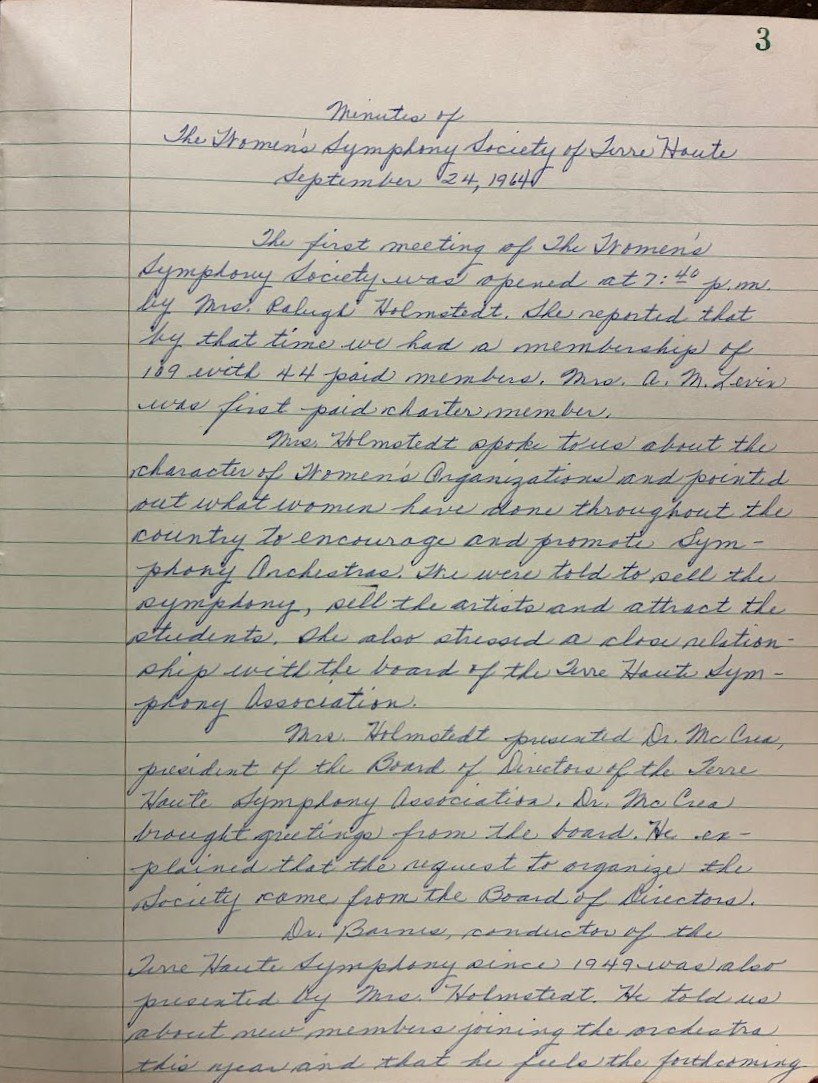
Photo of minutes from the first-ever meeting of the Women’s Symphony Society of Terre Haute, dated September 24, 1964. From the Women’s Symphony Society archive at Vigo County Public Library.
On September 24, 1964, the society met for its first official meeting and elected its first officers. Among them, Mrs. Holmstedt became the organization’s first president and Margaret Beecher became its first treasurer.** The photo at the top of this post was taken that day. Several guest speakers presented their vision for what the organization could be. Dr. Fred McCrea, recently elected president of the THSA Board, greeted the assembly and expressed his hope for a long and fruitful relationship between the two groups. Conductor Jim Barnes gave an overview of the symphony’s nearly-forty-year history and noted especially its close relationship to Indiana State.
Then Mrs. Holmstedt addressed the crowd, placed the organization within broader historical contexts, and rallied the group’s new members with a stirring charge: women in major cities across the country had risen to extraordinary challenges in supporting major orchestras for decades, and in so doing had created an expectation that every thriving and sustainable orchestra had a women’ auxiliary organization guaranteeing its survival. Now Terre Haute could say that it did too. “Terre Haute can take great pride in its Symphony Orchestra. It ranks as one of the best in the Middle West. And the women of Terre Haute, like women in other cities, should cherish their symphony and promote its welfare.”
The 200 women of the new Symphony Society got right to work. Their first big project was a “Symphony Blossoms” sale the following spring, featuring geraniums in red, white, salmon, and pink colors for 75 cents per pot. These were grown locally by Miller Floral Co. in their greenhouses at 1630 Plum Street (now a parking lot for DeVaney Elementary – named after Adelaide DeVaney, sister of Women’s Symphony Society member Grace DeVaney). The fundraiser was apparently successful enough that it continued annually for many years.
Legendary American conductor and composer Leonard Bernstein caught wind of the flower fundraiser in 1966 and sent the Society the following note of endorsement to help boost sales:

Portrait of Leonard Bernstein from 1971. Public domain. From Wikipedia.
I am informed of the Spring Flower Sale, sponsored by the Women’s Symphony Society, and I hasten to urge you all to support it to your utmost. It is from communities such as yours that the significant cultural expansions of our nation will arise. It should be not only your duty, but your honored privilege to participate in the growth of your communal musical life.
Signed, Leonard Bernstein
How in the world did Bernstein know about a flower sale in Middle America?! Was it true, as the Terre Haute Tribune reported, that he was “one of the Society’s strongest supporters?!” The rumor was that Society member Grace Knoepfler had reached out and asked him for comment. It was to his credit that he agreed to help!
(Author’s note: Does this note still exist somewhere?! I was unable to locate it among the Women’s Symphony Society archive at the public library.)
In September 1967, the Tribune reported that the THSO’s season-ticket sales effort was more critical than ever, and that the symphony’s needs had reached a dire point: “Without support of the public it has been noted by officers of the symphony association, this might be the last year for the symphony.” The Terre Haute mayor lent his municipal platform, declaring September 24-30, 1967, “Terre Haute Symphony Week.” The Women’s Symphony Society met at the Soeder home on 26th Street to brainstorm other ways to supplement their annual geranium sale. Several of the ideas generated at this meeting became regular features of the Society over the next decade. Starting in late autumn 1967, the Society held an annual Candle Bazaar, just in time for Christmas shopping; this eventually expanded to include gifts and wrapping paper sales. An annual Symphony Ball kicked off in 1969, and quickly became one of the highlights of city’s social calendar. And some activities became both fundraisers and perks for its members, who enjoyed Society-sponsored bridge tournaments, lectures by invited speakers, luncheons, coffees, teas, and pre-concert dinners. By 1970, the Society was generating more than $3,000 in annual support for the THSO.
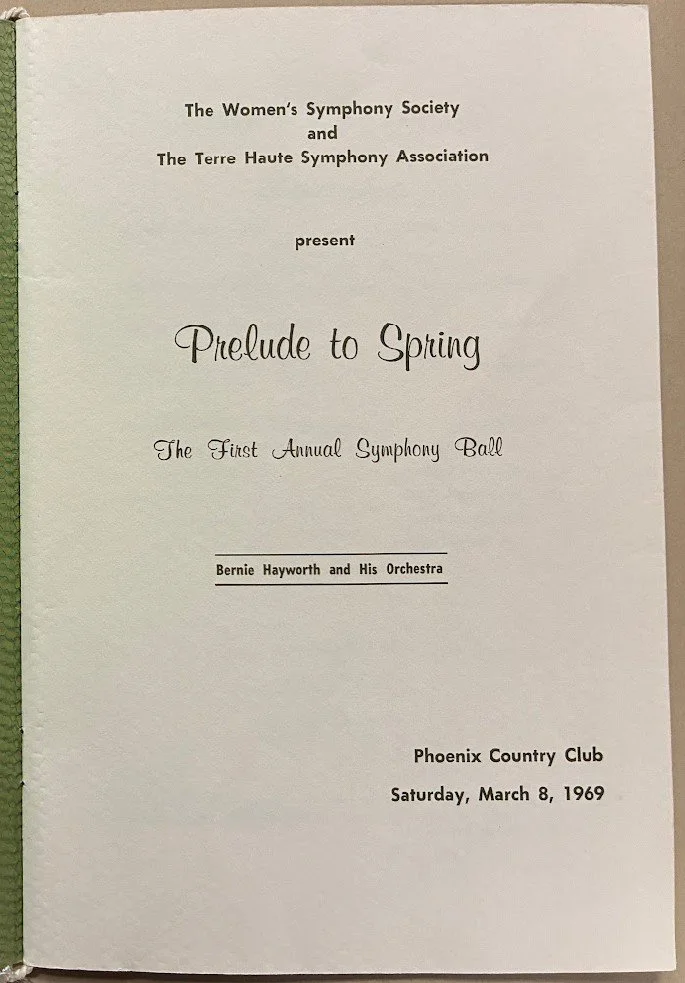
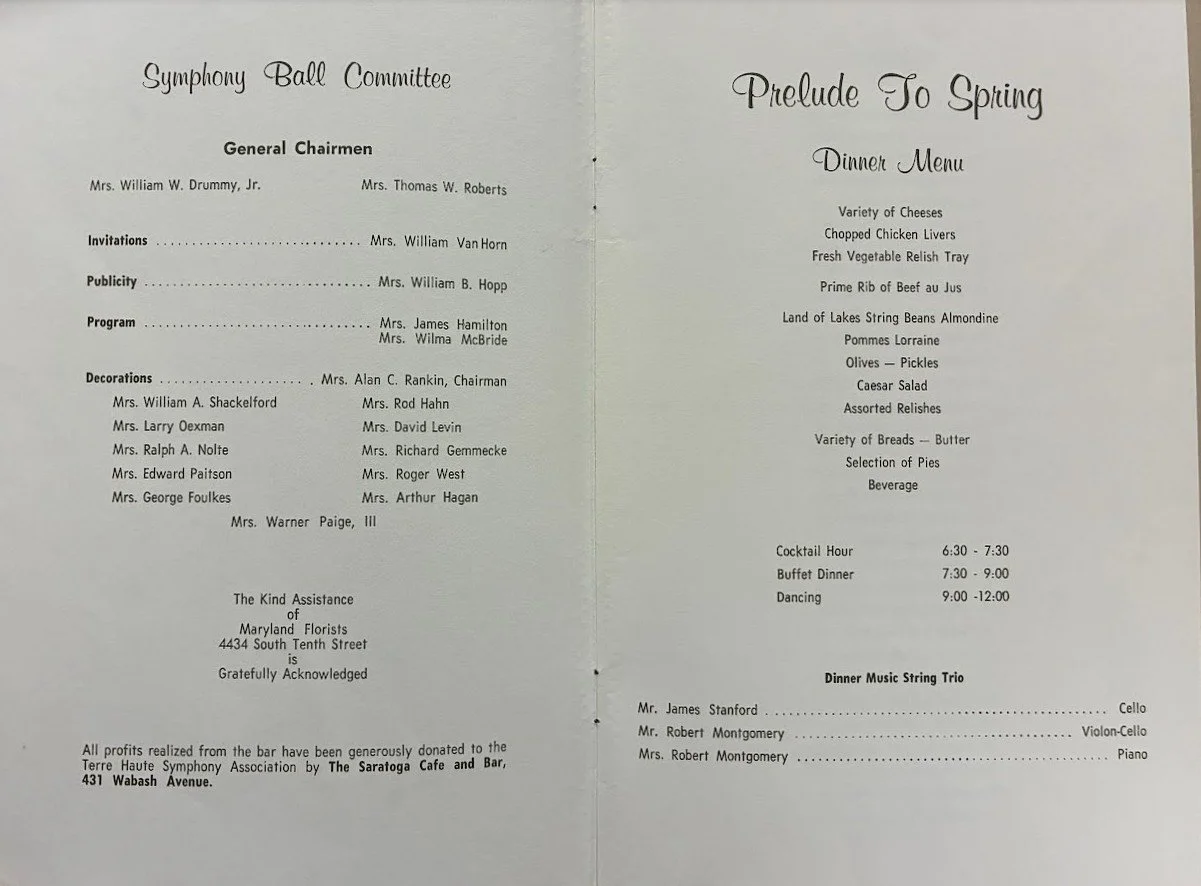
Program for the first annual Symphony Ball. From the Women’s Symphony Society archive at Vigo County Public Library.
After several years of concerted effort, the THSO enjoyed the most successful season-ticket drive in its history. For the 1973-1974 season, the symphony completely sold out of every one of the 1,710 seats in Tilson Music Hall before the season had even begun. It was an extraordinary achievement and a testament to its committed and hard-working community. Although ticket sales can never fully fund a professional symphony, the THSO did seem from the outside to be in good health as it approached its 50th anniversary in 1976.
(Author’s note: An earlier version of this post suggested that the sellout happened for two years in a row, but this was based on a date error in one of my sources.)
“TH Symphony Concerts for Season Sold Out”
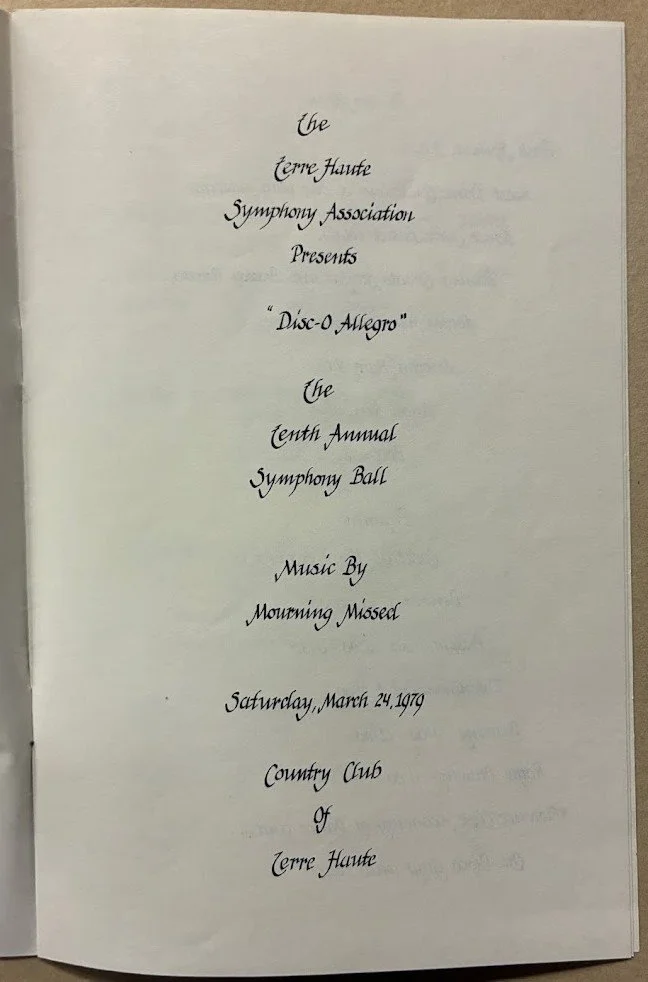
Program for the 1979 Symphony Ball. From the Women’s Symphony Society archive at the Vigo County Public Library.
The Women’s Symphony Society of Terre Haute continued holding events and raising money through the end of Victor Danek’s tenure as THSO conductor in 1977. Then, over the course of the year 1978, it became clear that the Society was rapidly losing its former energy. Minutes from May 1978 indicate that membership was down by half, at around 100 women. Profits from fundraisers had declined sharply and costs were on the rise, no doubt due to broad economic woes of that decade. Then, near the end of the minutes, appears the following note:
The president announced the inability of the Nominating Committee to provide a slate for election, asked for more support and suggestions from the membership to fill the office of president, lacking which the organization would cease to function.
A draft program from October 1978 includes this statement: “the Women’s Symphony Society is no longer able to function and will be disbanded, officially, very soon.” The tenth annual Symphony Ball was still held in March 1979, but was sponsored only by the Terre Haute Symphony Association. It was a quick and sad demise for the fourteen-year-old group that had contributed so much to the orchestra’s thriving.
The pause, thankfully, was only temporary.
In a future post we will investigate the organization that succeeded the Society only a couple of years later: the Terre Haute Symphony League! Today’s League now welcomes both men and women and continues to be a superstar of the THSO’s support system today!
Thank you, Symphony League!
If you enjoyed this post, consider… joining the Symphony League!


* “Mrs. H. V. Tatlock, Miss Grace DeVaney, Mrs. Merrill Bradfield, Mrs. Owen Eckert, Mrs. Richard Heustis, Mrs. Jack Weinbaum and Mrs. John K. Lamb.” Terre Haute Tribune-Star, July 12, 1964, page 17.
** “Mesdames Raleigh Holmstedt, president; Donald M. Sharpe, vice president; Owen L. Eckert, secretary; James L. Holler, corresponding secretary; and Samuel Beecher Jr., treasurer. Committee chairmen are Mrs. Donald Sharpe, membership; Mrs. Edwin P. Adkins, faculty and student participation; Mrs. George Carroll, social; Miss Jessie McCune, publicity; Mrs. Gale Clark, ways and means; Miss Grace DeVaney, telephone.” Terre Haute Saturday Spectator, October 31, 1964, page 47.
Sources on the Women’s Symphony Society’s first season:
Margaret M. Beecher, “Terre Haute Symphony Making Contribution to Community,” Terre Haute Tribune-Star, May 14, 1961, page 27.
Beecher, “Culture, Cash: Challenges for Community Idealists,” Terre Haute Tribune-Star, October 14, 1962, page 30.
Mrs. Robert Rust, “Symphony Group to Organize Women’s Guild,” Terre Haute Tribune, September 20, 1963, page 6.
“Dr. Fred McCrea Named President T.H. Symphony,” Terre Haute Tribune, June 10, 1964, page 13.
Beatrice Biggs, “Women’s Symphony Society Plans Advanced at Meeting,” Terre Haute Tribune-Star, July 12, 1964, pages 17 and 24.
“New Women’s Symphony Society Meets Thursday,” Terre Haute Tribune-Star, September 20, 1964, page 42.
Beatrice Biggs, “Women’s Symphony Society Discusses Plans for Future,” Terre Haute Tribune, October 4, 1964, pages 33 and 35.
“Women’s Symphony Society Sets Planning Meeting,” Terre Haute Saturday Spectator, October 31, 1964, page 47.
“Women’s Symphony Society Offers ‘Symphony Blossoms’,” Terre Haute Saturday Spectator, March 20, 1965, page 54.
Sources on Leonard Bernstein’s note to the Society:
“Noted Director Endorses Local Society Benefit,” Terre Haute Tribune-Star, March 27, 1966, page 21.
“Women’s Society in Final Week of Blossom Sale,” Terre Haute Tribune-Star, April 17, 1966, page 19.
“Symphony Group is Sponsoring Blossom Sale,” Terre Haute Tribune-Star, April 14, 1968, page 25.
Other sources:
“Symphony Week,” Terre Haute Tribune, September 22, 1967, page 8.
“Terre Haute Symphony Drive Deadline Near,” Terre Haute Tribune, September 29, 1967, page 8.
Gladys Seltzer, “TH Symphony Concerts for Season Sold Out,” Terre Haute Star, October 26, 1973, page unknown.
“Complete Sellout for Symphony,” Terre Haute Tribune, October 26, 1973, page 3.