
Victor Danek at the Podium, Part 1 (1970–1977)
David Chapman | August 7, 2026 | history@thso.org
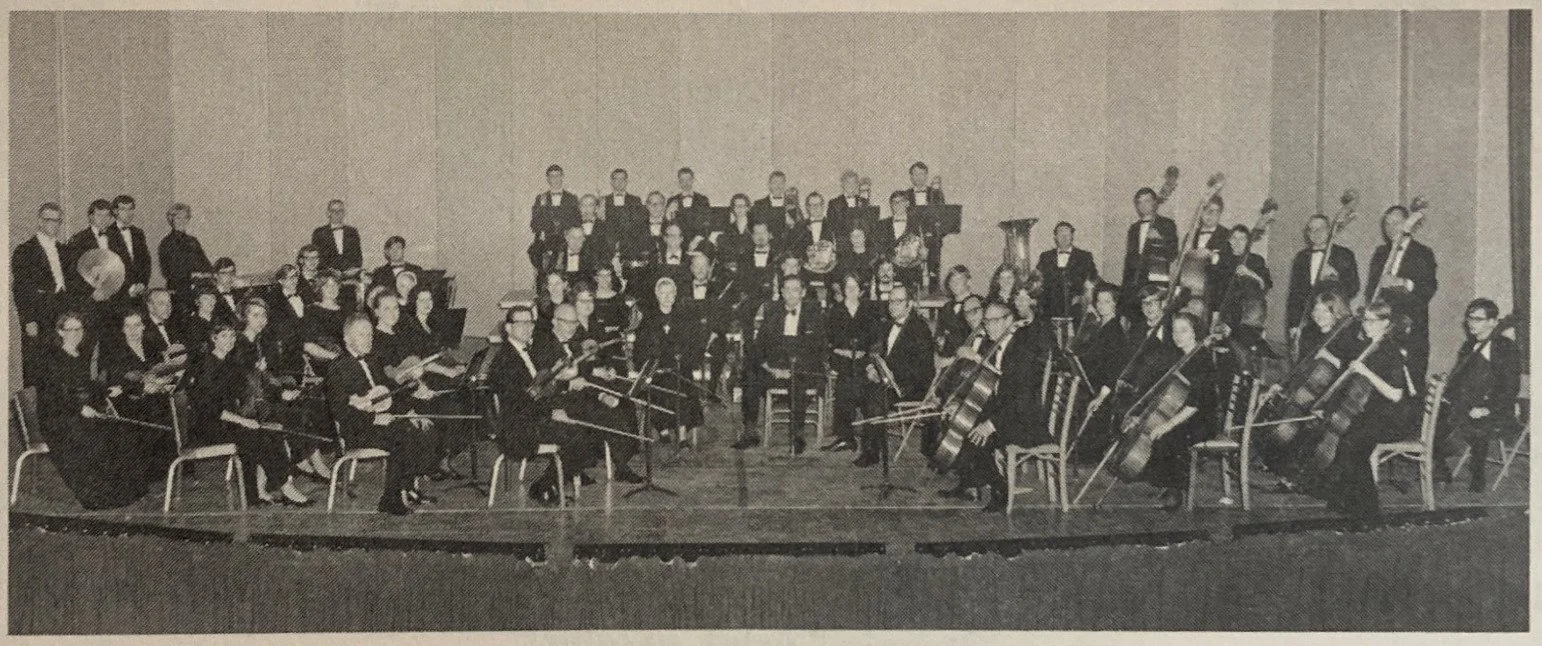
Photograph of the THSO in the 1970-1971 Season Brochure. From internal THSO archives.
Victor Danek was no stranger to the THSO when he took over as conductor in 1970. Like his predecessor James Barnes, Danek had played violin in the orchestra before he was promoted to the podium. But unlike Barnes’ single season as a section player, Danek had been principal second violin for all six years of his tenure as a THSO musician before becoming conductor.
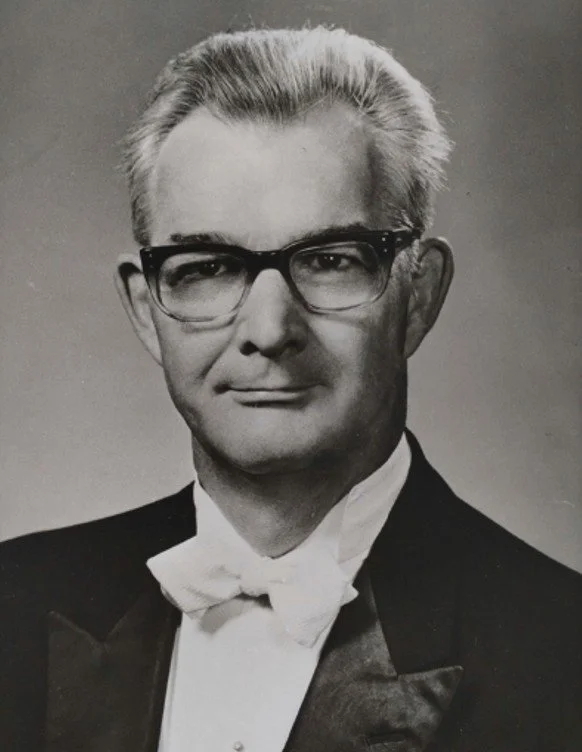
Portait of Victor Danek, ca. 1970, from internal THSO archives.
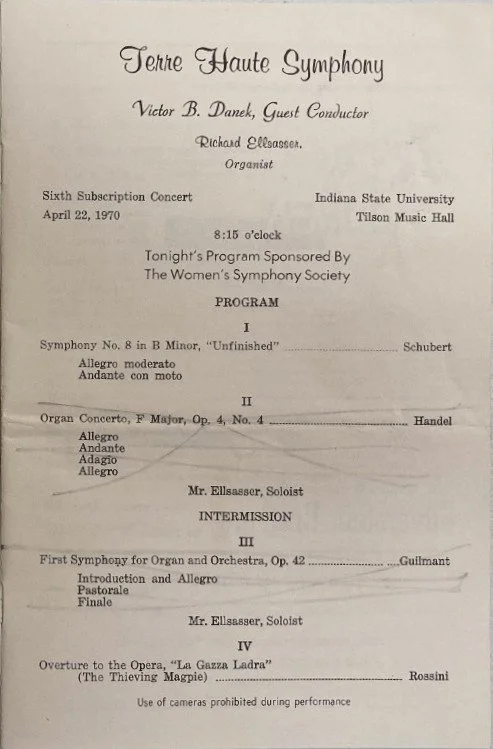
Program for the final concert of the Barnes era, which was Danek’s first appearance as conductor, months before he was given the job full-time. From internal THSO archives.
Actually, it was Danek who performed the last concert of the Barnes era. Organist Richard Ellsasser was scheduled to perform with the THSO late in the 1969-1970 season. There were no indications in any promotional materials or public media that Barnes would not conduct the April 22nd event, even as late as the week before. Then, three days before the concert, the Sunday edition of the Tribune-Star ran a preview that included a portrait of Danek alongside notice that he would be guest conductor. Reviews afterward noted that Danek had stepped up “owing to the recent indisposition of Dr. James Barnes.” Soon thereafter the THSA board of directors received Barnes’ resignation and hired Danek as THSO’s next conductor. Reasons for Barnes’ absence and resignation are not clear, but there are some indications that it was in part due to his need to focus on his work as Indiana State’s music department chair. Whatever the case, the Danek era began with the orchestra’s 45th season, 1970-1971.
(Side note: THSO publications from this era misstate — harmlessly, to be sure — the number of each season starting around 1960. I speculate that this is due to an ordinal-cardinal number confusion. We are all one year old throughout our second year of life, for example, resulting in what seems to be different numbers by count and by order. If 1926-1927 was the THSO’s first season, then 1966-1967 was its forty-first, and 1970-1971 was its forty-fifth. Similarly, the THSO will enjoy its 100th anniversary this coming December, in the middle of its 101st Season! Anyway, back to the history…)
Brochure cover for the 1970-1971 season, Danek’s first as conductor of the THSO. From internal THSO archives.
Victor Bartholomew Danek
Originally from Chicago, Danek came to Terre Haute in 1964 as do so many non-natives (including myself): for a job at one of the local colleges. He became a music professor at Indiana State, teaching conducting and orchestration and performing in the faculty string quartet with his ISU/THSO colleagues Paul Tarabek (violin), James Dailey (viola), and Robert Montgomery (cello).
Before moving to Terre Haute, Danek received bachelor’s and master’s degrees from the American Conservatory of Music in Chicago and a doctorate from Indiana University. As they do for so many musicians, music jobs had moved him all over the country before he landed back home again in Indiana. He had served as a violinist at San Antonio Symphony in Texas, Enid Symphony in Oklahoma, and the Birmingham Symphony in Alabama. While in Oklahoma he taught violin and music theory at Phillips University, and while in Alabama he served as music department head and fine arts chair at Judson College. For the decade prior to coming to Terre Haute, he served as music department chair at Indiana Central College (now the University of Indianapolis), and during that time he founded and conducted the Indianapolis Civic Orchestra. When Danek assumed the THSO podium in 1970, he was a well-seasoned orchestral veteran. He was a mature gentleman as well: Danek, age 55 in summer 1970, was older than his predecessor Barnes.
After the years of expansion and refinement under Barnes, the task for Danek and for the entire THSA organization was to sustain and build upon that momentum. It was a tall task. In addition to their regular THSO programming, the THSA continued to honor the mission of the Wabash Valley Civic Music Association with whom they had merged in the early 1960s. They hosted presentations by regional and national performing arts companies such as Butler University Ballet, Goldovsky Grand Opera Theater, the Singers and Dancers of Ljubljana, the Murray Louis Dance Company, the Ballet Aztlán de México, and the Indianapolis Ballet Theatre. Other non-THSO events included recitals by soloists and small ensembles, such as the Lenox Quartet, pianist Agustin Anievas, tenor Richard Tucker, flutist Jean-Pierre Rampal, the piano duo Anthony and Joseph Paratore, and pianist Manahem Pressler.
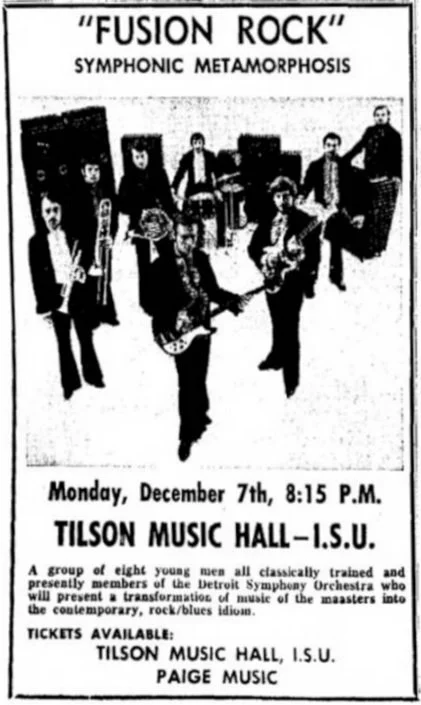
Advertisement for the THSA’s Symphonic Metamorphosis concert.
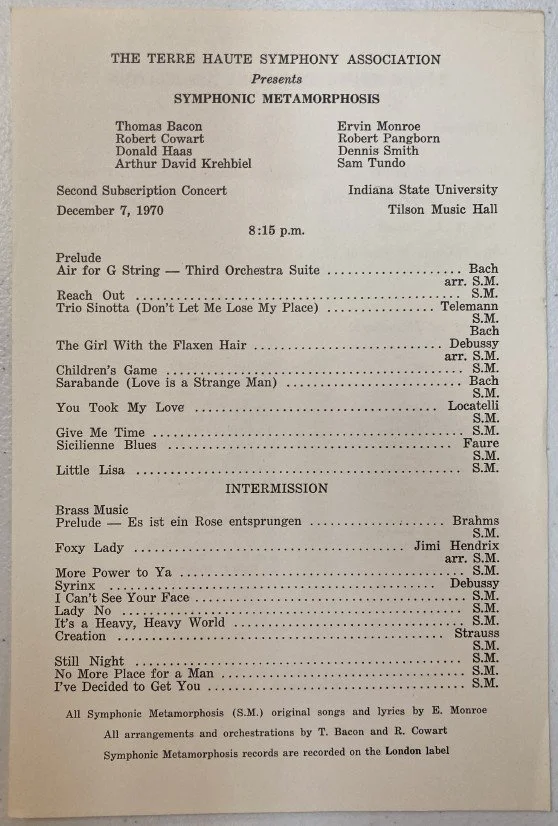
Program for the THSA’s Symphonic Metamorphosis concert. From internal THSO archives.
A particularly fascinating non-THSO event happened very early in Danek’s first year and thus was unlikely to have been his idea. Similar to Dave Brubeck’s visit in late 1960s, which explored fusions of jazz and orchestral music, a group of Detroit Symphony musicians who called themselves Symphonic Metamorphosis brought a fusion of 1970s-style art rock and classical repertoire to Tilson Hall. The event was a high-volume affair perhaps more suited to the Hulman Center arena and its long-haired college audience than the typical town-and-gown attendees of THSO.
Previews for the concert made their best pitch ahead of time, appealing to musical connoisseurs with the broadest range of musical tastes. The Terre Haute Tribune offered this take, quoting from the Detroit News: “If you are a true music lover, you probably enjoy listening to more than one type of music. Rock fans usually enjoy blues and jazz, and avante garde fans appreciate classical and chamber music. If you fall into any of these categories, a treat is in store for you when the Symphonic Metamorphosis presents a musical ‘happening’.”
Indiana State’s student newspaper, The Indiana Statesman, featured this statement from one of the band’s members: “Without having heard us, you might call us a cross between Blood, Sweat, and Tears; New York Rock ‘n’ Roll Ensemble and the Chicago Transit Authority. We have the potential of going any direction because our group is made up of persons who all have degrees in music and 10 to 15 years of experience in symphonic playing.”
“Detroit Concert Combo Shatters Sound Barrier”
It is unclear exactly how the audience responded at the event, but the reviews we do have were not especially kind. Frederick Black, an occasional performer with the THSO and frequent concert reviewer in the Terre Haute Star, described the audience applause throughout the concert as muted, but speculated that this may have been due to the profound volume contrast between the raucous music and the polite applause. Black’s review is critical, and perhaps all the more biting because he does not state directly his criticism, but disguises it with humor and metaphor. He began his review with a reference to contemporary national news stories, which had focused recently on Congressional efforts to pass the now-familiar OSHA law:
This reporter figures if he suffers any impairment of hearing as a result of listening to most of the concert Monday night by the Symphonic Metamorphosis […] he should be able to collect under the workmen’s compensation act.
Many articles have been written citing medical evidence that persons who spend much time listening to music played at the volume as heard in Tilson Music Hall do suffer a very real impairment in hearing.
These ears have served us for a good many years and we’d like them to serve us a few more.
Other members of the audience might consider suing the Terre Haute Symphony Association if loss of hearing resulted from exposure to sounds of such high decibel rating. (This was the second concert in Terre Haute Symphony series.) Probably that would be of no use since few were probably so naive as to expect to hear anything different from what was heard. They could have stayed home. […]
Black aimed his critique not just at the musicians but also at the THSA: “If music of this type were rarely heard and hard to find the Terre Haute Symphony Association would have owed it to its patrons to expose them to this music.” Buried under the conditionals “were” and “would” Black’s complaint seems to be that rock music is already everywhere, why subject us to it into the concert hall, too? As with jazz in the 1920s, there was a feeling among many classical enthusiasts that the concert hall could be some small refuge from the “kids these days” and their debauched noise.
A letter to the editor of the Terre Haute Tribune two days later reflected Black’s tone and argument:
Today’s general concept of a musician is grossly misunderstood probably because of a generation’s over-night ability to identify with sounds from amplified musical instruments; however, this group of men from Detroit are musicians by every legitimate definition, and by face of their credentials (seven principal chairs in the Detroit Symphony, and all with M.M.E. Degrees.) they are a collection of eight of this country’s finest musicians. Their two-hour concert was a great opportunity to witness the mastery of musicianship without a necessity of length rehearsals and tons of manuscript imperative to justify each individual’s profound talent as a soloist by his own expression. This time it was the musician instead of the music.
It is one thing to sell classical orchestra to rock fans, but another thing entirely to convince classical audiences of the virtues of rock music. When Brubeck appeared with the THSO in the Sixties, jazz was forty years old. There had been decades of successful fusions of jazz with the classical orchestra. The youthful jazz audiences from the 1920s were now firmly middle-aged and approaching retirement. Rock was arguably much newer — between ten and twenty years old, depending on who you ask — and successful rapprochements with classical orchestral music were either very recent (think progressive rock) or not yet attempted.
Most of the program presented to THSO audiences in 1970 were recorded on one or the other of the group’s two albums, which are available in full on YouTube (embedded below). Symphonic Metamorphosis dropped the word “symphonic” from their name before their second album in 1972. The band itself did not endure beyond that second album. And as far as I can tell, it was a long while before the THSO attempted to find common ground with rock music — though, to be clear, it has certainly done so, if last year’s Decades of Pop or the recent Luminous Strings concerts are any indication! These things do take time.
THSO concerts and guests artists of note
During Danek’s term as conductor, the THSO increasingly featured its own musicians as soloists, returning to a practice that had been more common before the WVCMA merger. The March 1971 concert, for example, opened with THSO percussionist Neal Fluegel performing Milhaud’s prickly but energetic one-movement Concerto for Percussion and Small Orchestra, and the first half closed with the oboist Bill Denton playing Vaughan Williams’ pleasantly romantic Oboe Concerto. Frederick Black was so much more enthused by this event than the rock concert earlier that season. This concert included Coleridge-Taylor’s “The Bamboula” and Mendelssohn’s “Reformation” Symphony, and Black declared afterward that “The Terre Haute Symphony established a new standard for musical excellence. After this we’ll have to judge the Terre Haute Symphony by big-league standards.”
The March 1972 THSO concert featured the orchestra’s concertmaster Paul Tarabek performing Vivaldi’s “Autumn” Violin Concerto “from his concertmaster’s chair,” as Frederick Black later described it, followed by principal bassoonist Stanley Petrulis on Mozart’s Bassoon Concerto. In October of that same year, the THSO introduced its new concertmaster Zoltan Szabo to the hometown audience by featuring him in Bruch’s lyrical First Violin Concerto. Principal trumpet Dalvin Boone was featured in February 1975 on Torelli’s Sinfonia von tromba. All of these featured musicians were also professors at Indiana State. And there must surely have been other examples where documentation is not currently available.
The THSO also continued performing with major celebrity guest artists. One of the biggest came in November 1973. The Danish-American pianist and comedian Victor Borge conducted and performed with the THSO, bringing his signature blend of vaudevillian silliness and classical music. In many ways it was a creative fusion not unlike Dave Brubeck or Symphonic Metamorphosis. Orchestral concert music has long had a reputation for being Very Serious Music, especially when compared to whatever is popular in a given era: classical music appeals to the brain, so the story goes, while rock-and-roll is for the body. And while I personally might quibble with such overly simplistic framing as myth and folly (and I would, indeed), enough people within and without classical music believe it that it continues even today. Mixing comedy with classical music goes a long way toward welcoming new audiences into the concert hall, while very usefully deflating the egos of Very Serious Musicians and their Very Serious Audiences. And Borge was a master at it.
Borge’s arrival into town was big news and local papers reported on his every move that day. Alongside his straightlaced long-time sidekick Marilyn Mulvey — an excellent coloratura soprano — Borge arrived at Hulman Field at 2:00pm on the day of the concert and were met by an entourage from the THSO. Danek, as well as THSA board president Benjamin Benjaminov and executive secretary Diane Chandler, received their guests and took them by taxicab to their hotel.
At the hotel they held a short press conference and fielded questions from reporters before their first and only rehearsal with the orchestra at 3:00pm. Had Borge been to Terre Haute before? Maybe, but couldn’t really remember. Do people realize he is an accomplished musician, or do they only see the comedy? Maybe, but it’s okay if people just enjoy themselves. How did he feel about being called a genius? Well, there is genius everywhere, and anyway, he just loves the work. How does one pull together a successful performance in a single day, with only one rehearsal? Well, everyone contributes their best effort and it just works, which is really an example of good democracy at work. With 20 minutes to spare, Borge and Mulvey headed to Tilson Hall where the orchestra was assembled and ready.
Borge and Mulvey performing in 1976, not long after appearing with the THSO.
In fact, the whole thing did not just come together in a single afternoon. Borge and Mulvey’s routine was well-honed and famous by then, and Danek had prepared and rehearsed the orchestra so that it was ready to join them. A maximum-capacity crowd attended the Borge performance; in fact, having Borge on the schedule was likely one of the main reasons for the extraordinary sellout of all season tickets that year. Mayor William Brighton presented Borge with a key to the city at intermission. Reviews afterward deemed the event a major success for the orchestra and noted especially the audience’s raucous enthusiasm… with a touch of snobbery as well: “It followed his usual format with him threatening to play but scarcely ever getting around to it, at least more than a few chords of anything. Which is in some respects fortunate,” Frederick Black wrote in the Star the day after.
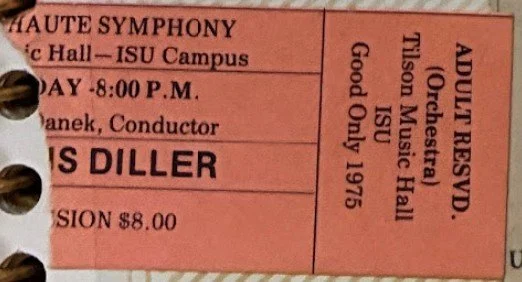
Torn ticket stub for Phyllis Diller’s appearance with the THSO in October 1975 — showing its original location in Tilson Hall before it was moved to the Hulman Center. From the archived scrapbooks of the Women’s Symphony Society at the Vigo County Public Library.
Another equally humorous superstar appeared with the THSO in October 1975. Phyllis Diller was perhaps even more broadly famous than Borge, and more outrageous in her comedy, too. She was a major star of stage, film, and television, and had recently begun as a regular panelist on Hollywood Squares. As a testament to her celebrity, Diller had been booked to perform with the THSO in early September but had to postpone her appearance to accommodate a film shoot. Because the Tilson was no longer available on the new date, the concert was moved to the Hulman Center — where Elvis had performed the prior July and KISS and Rush would appear in November. Previews for the concert — even the cover of the concert program itself — featured photographs of Diller in her familiar wigs and feathers and sequins. Audiences would naturally have expected a follow-up to Borge’s routine from two years before.
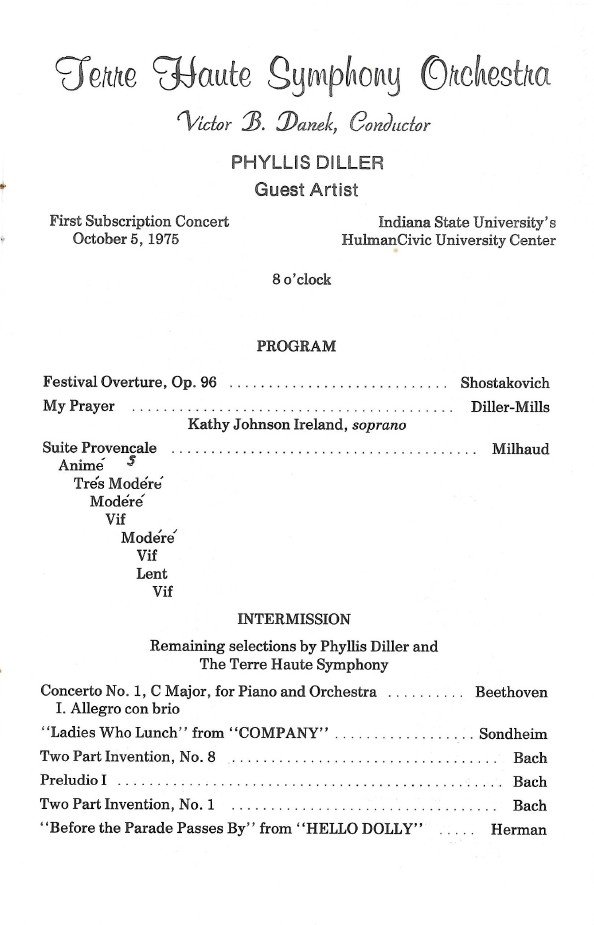
But while Diller’s appearance did feature dashes of comedy here and there, it was otherwise quite sober and serious, and surprisingly so. After an opening overture composed by Shostakovich, local soprano Kathy Johnson Ireland sang “My Prayer,” a song with lyrics by Diller set to music and orchestrated by Alvin Mills. Ireland had a special musical and personal connection to Diller: they had been classmates at the Sherwood Music School in Chicago in the 1930s, before Diller left behind her piano studies to pursue other career opportunities. The song was tender and pious in its effect, and reviewers noted especially Ireland’s beautiful performance.
After a suite by Darius Milhaud and intermission, Diller took the stage in an elaborately choreographed and absurdly grand entrance. She entered in spotlight, decked out in ostentatious furs and jewels, and so focused on the audience’s enthusiastic applause that she missed the aisle and walked directly into the first violin section, pausing periodically while violinists scrambled to move their chairs and make way for her. This was the Diller everyone had expected to see. When she reached the front of the stage, she insisted hilariously that the THSO concertmistress give up her own chair so Diller could use it at the piano. Each row of violinists then had to give up a seat to accommodate the row in front of them, until a piano bench appeared from offstage for a back-row violinist to sit on.
Then, in a symbolic gesture, she shed her glitzy coat and jewelry and dropped them on the stage, whereupon two men carried them off on a stretcher. A more simply dressed Diller sat at the piano ready to perform the opening movement of Beethoven’s First Piano Concerto in relatively straightforward fashion. This was the more serious Diller that had surprised audiences since she started performing with orchestras in 1971.
After a competent performance of the Beethoven, Diller performed two Broadway showtunes and several solo Bach pieces. Audiences roared their approval. Mayor Brighton, as he had done for Borge two years before, presented Diller with a key to the city. Frederick Black reported in the Star on all that had transpired — and grumped a little that he hoped the orchestra would get back to just playing beautiful music soon.
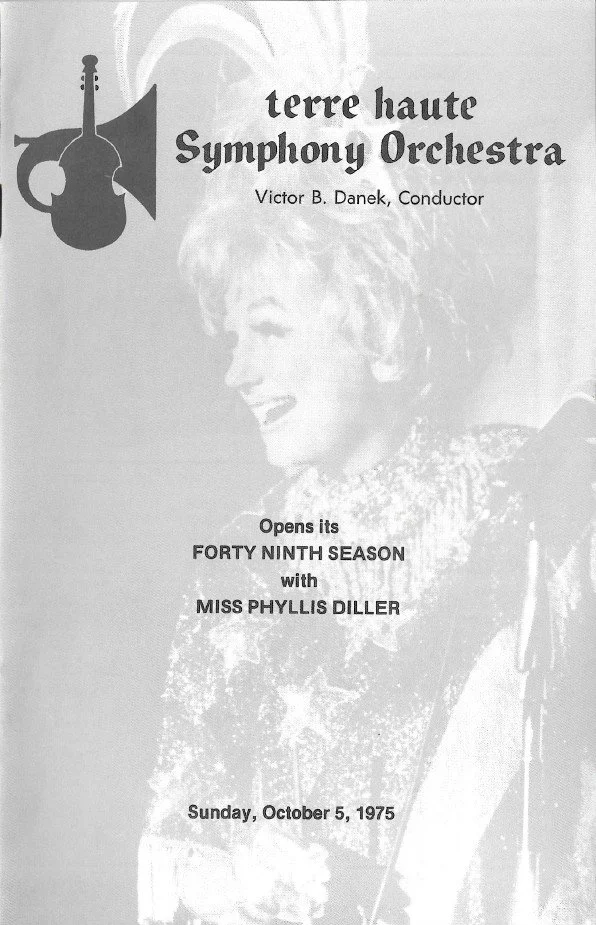
Program for Phyllis Diller’s guest appearance with the THSO. From a photographed program provided by Gary Brown.
In a future post, we will finish the Danek era with an examination of some of the considerable challenges that arose in this era: Danek’s leaves of absence and frequent need for substitute conductors, for example; the formation and challenge of sustaining a chorus as yet another organization under the THSA banner; tensions with the musician union; and more.
If you enjoyed this post, consider supporting your hometown symphony with $100 for #THSO100 — a C-note for a Century!
Click here to donate.
Sources on the beginning of the Danek era:
“Terre Haute Symphony to Present Noted Organist,” Terre Haute Tribune-Star, April 12, 1970, page 40.
“Local Symphony Will Feature Guest Conductor,” Terre Haute Tribune Star, April 19, 1970, page 38.
Frederick Black, “TH Symphony Heard in Finale of Season,” Terre Haute Star, April 23, 1970, pagination unknown.
“Symphony, Guest Well Recieved in Concert,” Terre Haute Tribune, April 23, 1970, page 6.
“Danek Begins Rehearsals for TH Symphony,” Terre Haute Tribune, September 18, 1970, page 27.
“This Year Make the Terre Haute Symphony a Family Affair,” Terre Haute Tribune-Star, October 4, 1970, Rotogravure.
“T H Symphony Will Open New Season on Oct. 21” Terre Haute Tribune-Star, October 11, 1970, page 71.
Sources on the Symphonic Metamorphosis concert:
“Detroit Symphony Group to Appear in Concert,” Terre Haute Tribune, November 29, 1970, page 42.
“Concert Features Rock, Electronic Music,” Indiana Statesman, December 3, 1970, pagination unknown.
“Terre Haute Symphony Presents Unusual Program,” Terre Haute Saturday Spectator, December 5, 1970, page 5.
“Symphonic Metamorphosis Concert Monday,” Terre Haute Tribune-Star, December 6, 1970, page 40.
Frederick Black, “Detroit Concert Combo Shatters Sound Barrier,” Terre Haute Star, December 8, 1970, pagination unknown.
“Symphonic Metamorphosis,” Indiana Statesman, December 9, 1970, pagination unknown.
Thomas A. Stergar, letter to the editor, Terre Haute Tribune, December 10, 1970, page 8.
Sources on THSO musicians as featured performers:
Neal Fluegel, percussion, and J. William Denton, oboe
“Neal Fluegel to Perform with Symphony Orchestra,” Terre Haute Tribune-Star, February 21, 1971, page 15.
“Youth Symphony Concert to Precede TH Orchestra,” Terre Haute Tribune, March 9, 1971, page 7.
Frederick Black, “TH Symphony Achieves Major Concert Hall Status,” Terre Haute Star, pagination unknown.
“Youth and TH Symphony Concerts Warmly Received,” Terre Haute Tribune, March 11, 1971, pagination unknown.
Paul Tarabek, violin, and Stanley Petrulis, bassoon
“Terre Haute Symphony to Feature Own Artists,” Terre Haute Tribune, March 5, 1972, page 41.
Frederick Black, “Terre Haute Symphony Given Warm Applause,” Terre Haute Star, March 8, 1972, pagination unknown.
“Symphony Concert Warmly Received,” Terre Haute Tribune, March 8, 1972, pagination unknown.
Zoltan Szabo, violin
“T.H. Symphony Concert will Feature Szabo,” Terre Haute Tribune, October 1, 1972, page 23.
Sources on Victor Borge’s appearance with the THSO:
“TH Symphony Assoc. Sets Victor Borge Concert,” Terre Haute Tribune, November 25, 1973, page 65.
“Victor Borge and Marilyn Mulvey Slated Here Wednesday,” Terre Haute Star, November 26, 1973, page 3.
“Borge Concert Here Wednesday,” Terre Haute Tribune, November 26, 1973, pagination unknown.
Gladys Seltzer, “Borge Exhibits Typical Humor,” Terre Haute Star, November 28, 1973, pagination unknown.
Frederick Black, “Symphony Patrons Get Money’s Worth,” Terre Haute Star, November 29, 1973, pagination unknown.
“Borge Concert Was Success for Symphony,” Terre Haute Saturday Spectator, pagination unknown.
“Victor Borge Concert Termed Huge Success,” Terre Haute Tribune, November 29, 1973, pagination unknown.
Sources on Phyllis Diller’s appearance with the THSO:
“Diller at Piano,” Indianapolis Star, May 12, 1975, page 14.
“Phyllis Diller Rescheduled,” Terre Haute Saturday Spectator, September 20, 1975, page 21.
“Diller Becomes Regular on ‘Hollywood Squares’,” Terre Haute Tribune, September 20, 1975, page 13.
“Singer Joins Diller Show,” Evansville Courier and Press, October 5, 1975, page 103.
“Phyllis Diller Entertains for TH Symphony Opener,” Terre Haute Tribune, October 6, 1975, page 5.
Dave Cox, “Phyllis Diller Opens Season for Terre Haute Symphony,” Terre Haute Star, October 6, 1975, unknown pagination.
Frederick Black, “Large Enthusiastic Audience Enjoys Phyllis Diller — the Concert Pianist,” Terre Haute Star, October 6, 1975, unknown pagination.
“A Diller of an Evening,” Terre Haute Saturday Spectator, October 15, 1975, page 19.